
Füssen from Munich: The Town, the Castles and Whether to Stay
Most people race through Füssen on the way to Neuschwanstein and miss the prettiest Alpine old town in Bavaria. Here is how to reach Füssen from Munich, what's worth your time in the town itself, how it gives you the castles, and the honest case for staying the night rather than dashing back.
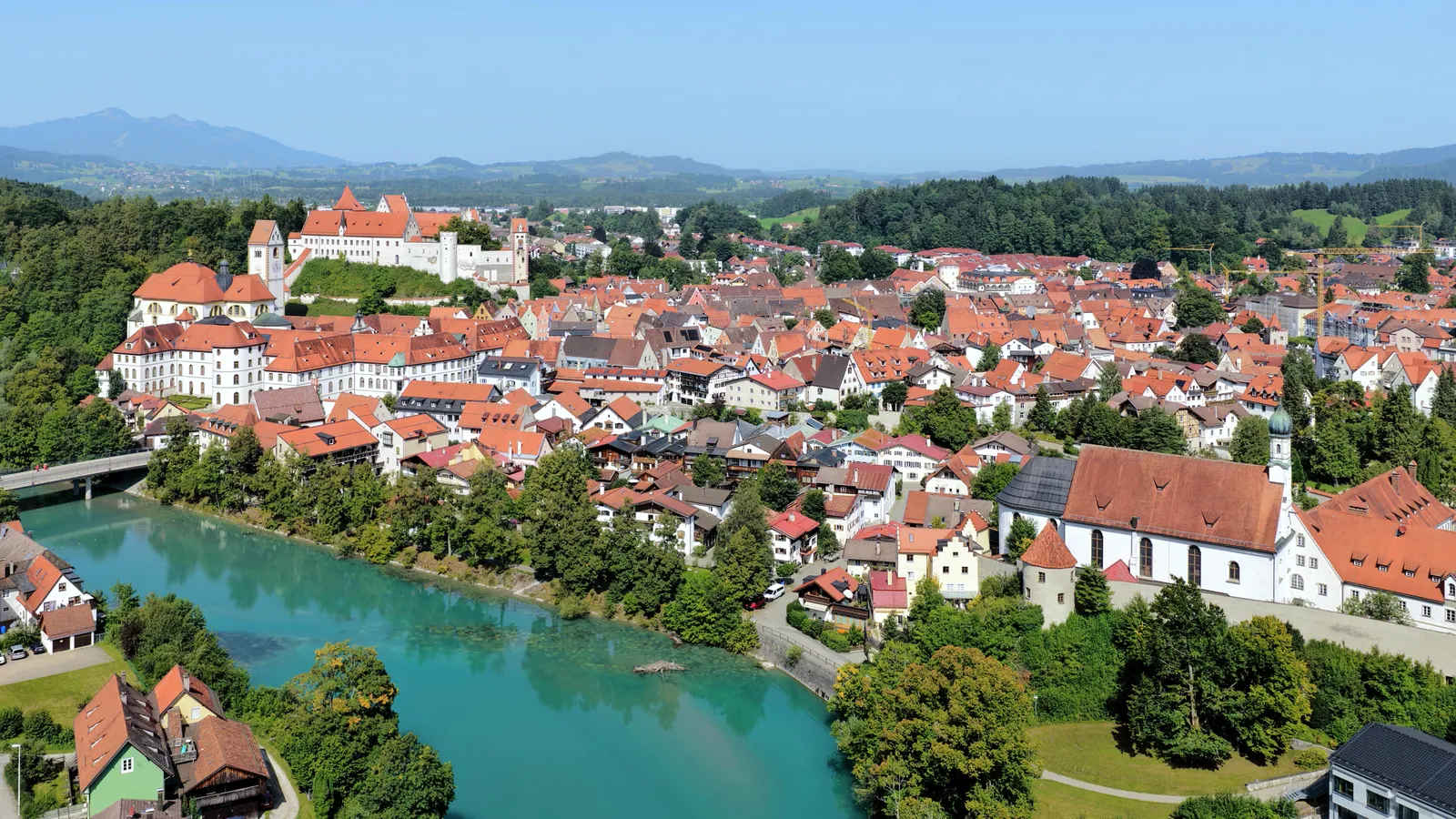
Photo: C.Stadler/Bwag / Wikimedia Commons · CC BY-SA 4.0

- ✓Füssen is a colourful, walkable Alpine town at the very southern tip of Bavaria — the end of the Romantic Road, framed by the Lech river, the High Castle and the mountains.
- ✓It's the gateway to Neuschwanstein and Hohenschwangau: the castle village of Hohenschwangau is a short bus ride away, which is why so many day-trippers pass straight through.
- ✓By train it's about two hours from Munich, the end of the line — easy as a day trip, but the town rewards an overnight if you can spare one.
- ✓Slow down for the old town, the painted High Castle, the riverside walks and the nearby lakes, and Füssen becomes a destination in its own right rather than a stepping stone.
What Füssen is — more than the road to the castle
Füssen sits at the southern edge of Bavaria, hard against the Austrian border, where the flat Alpine foreland finally rises into mountains. It's a small, handsome town built where the river Lech tumbles out of the hills, and it has been a crossing-point and a place of craft for centuries — once famous across Europe for making lutes and violins. The result is an old town of narrow, colour-washed streets, frescoed façades, church towers and arcades, watched over by the Hohes Schloss, the High Castle, with its painted trompe-l'œil walls. It is, quite simply, one of the loveliest small towns in southern Germany, and the official southern terminus of the Romantic Road, the scenic route that winds down through medieval Bavaria.
And yet most visitors barely see it. Füssen's modern fame is as the base for the two royal castles a few minutes up the valley — Neuschwanstein and Hohenschwangau — and the great majority of people who come this far arrive on a tight schedule, change straight onto a castle bus, and never set foot in the old town at all. That's the opportunity here: linger in Füssen itself and you get an Alpine town with all the charm and few of the crowds that mob the castle hill, plus easy access to the castles, the lakes and the mountains when you want them.
Getting there by train — the easy independent route
Reaching Füssen from Munich is refreshingly simple, because it's the end of the line. A regional train runs from Munich Hauptbahnhof to Füssen station in around two hours — sometimes direct, sometimes with one change, often at Buchloe. The trains are comfortable regional services, not high-speed, and the latter part of the journey rolls gently into the foothills, so the ride is a pleasant part of the day rather than a chore.
For the fare, the smart buy is usually the Bayern-Ticket, the Bavaria day pass, which covers the regional train down and back and the local castle buses too, for one flat price — and it's especially good value for two or more people travelling together. Note the Bayern-Ticket's rules: on weekdays it's valid from 9am, which suits the castles fine but means an earlier train needs a different ticket. Always check the morning departures and the current fares before you go, as timetables and prices change. Our public-transport guide explains how the Bayern-Ticket and regional services work.
Because Füssen is the terminus, there's no risk of overshooting your stop, and the station sits a short, signposted walk from the old town. The castle buses to Hohenschwangau leave from right outside the station, which is exactly why it's so easy to skip the town — so make a point of walking into the old centre first.


Füssen and the castles — how the town gives you Neuschwanstein
Füssen is the natural base for the two castles, and the logistics are straightforward. From Füssen station, the well-signed castle buses (typically lines such as 73 or 78) run the short hop — around ten minutes — to Hohenschwangau, the village at the foot of both castles. From there you collect or validate your timed castle ticket at the village ticket centre and climb up. The key thing to understand is that Neuschwanstein's interior can only be seen on a timed guided tour with limited tickets, so the single most important piece of planning is to book that tour slot in advance; our Neuschwanstein guide walks through the whole booking-and-climbing process.
If you're staying in Füssen rather than day-tripping from Munich, you have a real advantage: you can be on the first morning bus to Hohenschwangau and at the castle ahead of the day-trip coaches that pour in from the city later. The flip side, for a pure day-tripper, is that Füssen-plus-Neuschwanstein is a genuinely full day — two hours each way on the train, plus the bus, the climb and the timed tour — which is the strongest argument for either keeping the day castle-focused or, better, giving the whole area an overnight so you're not rushing.
What to see in Füssen itself
Give the town an unhurried couple of hours and it repays you. The heart is the old town's main street and the lanes around it — pastel houses, painted gables, arcades, and small squares with café tables — perfect for an aimless wander. Above it stands the Hohes Schloss, the High Castle, the former summer residence of the prince-bishops of Augsburg, celebrated for the painted illusionistic 'architecture' on its courtyard walls and home to a regional gallery; the courtyard and the views over the rooftops are worth the short climb even if you don't go into the galleries.
Just below sits the former Benedictine monastery of St. Mang, a grand Baroque complex by the river that houses the town museum — including its proud history of lute- and violin-making — alongside an atmospheric church. Then there's the river itself: the Lech runs a startling glacial turquoise here, and the riverside paths and the Lechfall, a small waterfall just upstream of the town, make for an easy and beautiful short walk. None of this takes long, and all of it is a world away from the crush at the castle gate. Confirm opening hours and admission for the High Castle galleries and the St. Mang museum on the town's official site before you plan a visit around them.
- The old town: pastel streets, painted façades, arcades and café squares — best simply wandered.
- Hohes Schloss (High Castle): the painted illusionistic courtyard and rooftop views; a regional gallery inside.
- St. Mang monastery and museum: Baroque architecture, the town museum and Füssen's lute-making heritage.
- The river Lech and the Lechfall: glacial-turquoise water and an easy riverside walk to a small waterfall.

The lakes and mountains around Füssen
Part of Füssen's appeal is how much sits within a few minutes of it. Just south, on the way to the castles, lie the Alpsee — the clear, swimmable lake beneath Hohenschwangau — and the Schwansee in its little nature park, both lovely for a walk or a summer swim. A short way out are the broad Forggensee and Bannwaldsee, with lakeside paths, summer boat trips and bathing spots. And the mountains themselves rise right behind the town: the Tegelberg cable car climbs to a ridge with sweeping views and trails, a tempting add-on if the weather is clear and you have time.
This is the real argument for not treating Füssen as a mere bus interchange. With a half-day to spare you can swim in an Alpine lake, ride a cable car to a summit panorama, or walk a glacial river — the kinds of things that turn a castle errand into a proper mountain day. Check seasonal opening for the cable car and any lake boats, which run mainly in the warmer months.
Füssen and the Romantic Road
Füssen's other claim to fame is its place at the very end of the Romantische Straße — the Romantic Road, Germany's best-known scenic touring route, which threads down through a string of walled medieval towns and Bavarian countryside from Würzburg in the north to here at the foot of the Alps. Füssen is the southern terminus, the romantic flourish where the road finally meets the mountains. You don't need to have driven the whole route to enjoy that — but it explains the town's polish and its long habit of welcoming travellers, and it makes Füssen a natural anchor for anyone stitching together a wider Bavarian loop.
That heritage shows in the details. The town has been a place of crossing and trade since Roman times — it sits on the old Via Claudia Augusta route over the Alps — and later grew prosperous on craft, above all the making of lutes and violins, a trade celebrated in its museum. All of that history is packed into a compact, walkable centre, which is part of why an unhurried hour or two here feels so rewarding: there's real depth beneath the pretty façades, and it's all within a few minutes' stroll of the station and the castle buses.

Day trip or overnight? The honest call
You can absolutely do Füssen and Neuschwanstein as a day trip from Munich, and many people do — take an early train, book your castle tour for late morning or early afternoon, see the castle, and squeeze in a quick look at the town before the long ride home. But it's a packed, tightly timed day, and the town and its lakes get short shrift. If your only goal is to tick off Neuschwanstein, the day trip works fine; just go early and book ahead.
If, on the other hand, you've fallen for the idea of Füssen as a place rather than a transfer point, an overnight transforms the visit. Staying lets you do the castles first thing — ahead of the coach crowds — and then have the rest of a day and an evening for the old town, a lake swim, a riverside walk or the cable car, at a gentler pace. It also opens up the wider Alpine corner: an overnight here is a natural springboard to a longer loop through castle country and the mountains. For couples especially, a night in this colourful little Alpine town, with the High Castle floodlit and the river running below, is one of the more romantic things you can do within easy reach of Munich.


At a glance
A quick planning reference. Verify the volatile details — train and bus times, fares, castle-ticket booking, cable-car and boat seasons, and museum hours — on the official sources before you travel.
- Where: Füssen, the southern tip of Bavaria on the Austrian border — the end of the Romantic Road.
- By train: regional train from Munich Hauptbahnhof, ~2 hours, the end of the line (sometimes a change at Buchloe).
- Ticket: a Bayern-Ticket covers the train and the local castle buses for one flat fare — good value for two or more.
- For the castles: castle buses (lines such as 73/78) from Füssen station to Hohenschwangau (~10 min); book Neuschwanstein's timed tour ahead.
- In the town: the old town, the painted High Castle, the St. Mang monastery museum, and the turquoise Lech and Lechfall.
- Nearby: Alpsee and Schwansee, the Forggensee, and the Tegelberg cable car (seasonal).
- Day trip vs overnight: a doable but tightly timed day trip — but the town and lakes reward staying the night.

The Best Day Trips from Munich
Munich is one of Europe's great launch pads — castles, Alpine peaks, turquoise lakes, half-timbered towns and even another country are all an easy train ride away. Here is how to choose between them and plan a day that works.
Read guide
Neuschwanstein from Munich: How to Visit
The fairy-tale castle is the most popular day trip from Munich — and the one that most rewards planning. Here is the honest guide to trains versus tours, the timed-ticket system, and a realistic day-plan that doesn't end in a missed connection.
Read guide
Linderhof Palace from Munich
How to reach Ludwig II's jewel-box Linderhof palace from Munich — tickets, the famous gardens and grotto, the transport realities, and how to combine it with Ettal or Neuschwanstein.
Read guideMore in Day Trips
6
Ammersee from Munich
How to do Ammersee as a relaxed day trip from Munich — the direct S-Bahn, lake boats and swimming, a hilltop monastery brewery at Andechs, and a fully car-free plan.
Read guide
Andechs Monastery from Munich: The Pilgrimage-and-Beer Day
The Holy Mountain of Andechs pairs a Baroque pilgrimage church with one of Bavaria's most famous monastery breweries, half an hour's drive south-west of Munich above the Ammersee. Here is how to reach it by transit or car, and how to turn it into one of the loveliest easy days out from the city.
Read guide
Augsburg from Munich
How to do Augsburg as a day trip from Munich — the short, frequent train hop, a one-day walk through the Renaissance Old Town, the Fuggerei almshouse, the UNESCO water-management heritage, and where to eat.
Read guide
Bavarian Alps Day Trips from Munich: Which One to Pick
Munich sits an hour or two from the Bavarian Alps, and on a clear day you can see them from the city. This is the compare-and-choose guide to the best Alpine day trips — Germany's highest peak, the Olympic town, the jewel lakes, the Eagle's Nest and castle country — so you can match the mountains to your day.
Read guide
Berchtesgaden and Eagle's Nest
How to reach the Eagle's Nest and the Berchtesgaden valley from Munich — the seasonal road, the Königssee, the dark history, and whether to go independently or by guided tour.
Read guide
Chiemsee and Herrenchiemsee
How to do the Chiemsee and Ludwig II's island palace of Herrenchiemsee from Munich — chaining the train, the lake boat and the palace timing into one graceful day.
Read guide