
Munich Public Transport Guide
How Munich's MVV network actually works for visitors — the U-Bahn, S-Bahn, trams and buses on one ticket, the zone system, validation, the apps that make it painless, and the small habits that mark you out as someone who knows the city.

Photo: Jakub Żerdzicki / Unsplash

- ✓Four modes, one ticket: the MVV runs the U-Bahn, S-Bahn, trams and buses on a single fare system — buy once and transfer freely within the time and zones your ticket covers.
- ✓Munich uses a zone system built in concentric rings (M, then 1, 2, 3 outward); almost everything a visitor wants sits in Zone M, the central white zone.
- ✓There are no ticket barriers — the system runs on trust and spot checks, so an unvalidated or wrong ticket counts as fare-dodging with a fixed penalty.
- ✓The S-Bahn trunk line (Stammstrecke) threads every S-Bahn through the centre — Hauptbahnhof, Marienplatz, Isartor, Ostbahnhof — so most cross-town hops are direct.
- ✓Apps do the thinking for you: the MVGO and MVV apps plan routes, sell mobile tickets and show live departures.
One network, four ways to move
Munich's public transport is one of the genuine pleasures of the city — quiet, clean, almost theatrically punctual, and so well joined-up that you can land knowing nothing and be navigating like a local by lunchtime. The whole thing runs under one umbrella, the MVV (Münchner Verkehrs- und Tarifverbund), which is the fare network that ties together four modes of transport so that a single ticket carries you across all of them. You don't buy a separate fare for the metro and the tram; you buy one MVV ticket and use whatever moves you fastest.
The four modes each have a job. The U-Bahn (the underground, lines prefixed U) is the workhorse for getting around the city itself, fast and frequent below the streets. The S-Bahn (suburban rail, prefixed S) handles the longer hauls — out to the airport, the lakes and the day-trip towns — but doubles as a fast cross-centre shuttle because every line funnels through the same central tunnel. Trams (prefixed with a number, e.g. line 19) glide across the surface and are often the prettiest way to cross town. Buses fill in the gaps the rails miss. Locals rarely think in mode names; they think in line numbers and colours, and so should you.

The zone system, demystified
Munich prices fares by zones arranged as concentric rings spreading out from the centre. The innermost is Zone M (the white zone), which covers the whole city proper — and that single fact resolves most visitor confusion, because virtually everything you've come to see sits inside Zone M: Marienplatz, the English Garden, the museums, Nymphenburg, the Olympiapark, the Allianz Arena. Beyond M the rings are numbered 1, 2 and 3 as you head outward into the surrounding region, and a journey is priced by how many zones it crosses.
The practical upshot: if you're staying central and sightseeing in the city, you live in Zone M and a Zone-M day ticket does almost everything. The two places that pull you further out are the airport, which sits in Zone 5 (the outermost ring) and so needs a ticket spanning M through 5, and certain day trips on the S-Bahn — Dachau, the lakes, Herrsching for Andechs — which reach into zones 1, 2 or 3. Always check which zones a journey touches before you buy; the route planners spell it out for you, which is exactly why locals lean on the app rather than doing zone arithmetic in their heads.
Validation, barriers and the honour system
Here is the single most important thing for a newcomer to understand, because getting it wrong is the one way to turn a smooth transit experience sour: Munich has no ticket barriers. You walk straight onto the platform or the tram. The system runs on trust, backed by plain-clothes inspectors (Kontrolleure) who board at random and ask to see a valid ticket. A passenger without one — or with an unvalidated one — is treated as a fare-dodger (a Schwarzfahrer) and charged a fixed penalty on the spot, regardless of intent. Tourists get caught by this every single day, and 'I didn't know' is not a defence that works.
So the rule is simple: always carry a valid, validated ticket. Mobile tickets bought in the app are active from the moment you buy them and need no further stamping — which is the easiest, most foolproof route and the reason most visitors should just use the app. Paper tickets from a machine usually need validating before your first journey: look for the small blue or grey stamping boxes (Entwerter) on station platforms and inside trams and buses, and push the ticket in to print the time and place. A day ticket or a pass is generally valid from validation/purchase, but always read what you bought. When in doubt, validate.
- Mobile (app) tickets: valid from purchase — no stamping needed. The simplest option for visitors.
- Paper single/strip tickets: must be stamped in an Entwerter box before you ride, every time.
- Day tickets and passes: valid for the period stated, from validation or activation — check the wording.
- No ticket or an unvalidated one = a fixed penalty if an inspector boards. Verify the current fine amount; it is set to deter, not to forgive.
How the lines actually fit together
Once you grasp the geometry of the network, Munich opens up. The S-Bahn is the key. All of its lines (S1 through S8) share one central tunnel — the Stammstrecke, or trunk line — that runs east–west through the heart of the city, stopping at Hauptbahnhof, Karlsplatz (Stachus), Marienplatz, Isartor and Ostbahnhof. That means almost any S-Bahn you board, no matter where it's ultimately headed, will carry you across the centre on the same handful of stops. For a visitor, the trunk line is a free gift: hop on any S-Bahn going your direction and you'll hit Marienplatz.
The U-Bahn weaves a denser web for getting around the city itself, with interchanges that let you cross from one line to another without surfacing. Trams are the surface layer — slower but lovely, and the best way to see the city go by; lines like the 19 string together useful stops across the centre. Buses, including the handy MetroBus routes, reach the corners the rails don't. The names matter less than the numbers and the direction: every platform sign shows the line's final destination, so navigation is really just 'which line, and which end of it am I heading toward?'

The apps that make it painless
You can absolutely do Munich on paper tickets and platform maps, but the easy way is to let an app carry the load. The two worth your phone's home screen are the MVGO app (Munich's transit operator) and the MVV app (the fare network). Both plan door-to-door routes, tell you precisely which zones a journey crosses and therefore which ticket to buy, sell you that ticket on the spot as a mobile fare, and show live departures so you know whether to dawdle over your coffee or break into a jog. Google Maps also reads the network well for routing, though buying tickets is cleanest in the official apps.
Two small habits pay off. First, download and set up your app of choice before you arrive, ideally with a payment method already attached, so your first ticket is a thirty-second affair rather than a scramble at the airport machine. Second, trust the planner on zones: rather than memorising the ring system, type in where you're going and let it tell you the fare. Munich's network is so reliable that the app's predictions are essentially the timetable — if it says the U-Bahn comes in three minutes, set your watch by it.
- MVGO and MVV apps: route planning, live departures and mobile ticket purchase in one place.
- Set up the app and a payment method before you land — your first ride should be frictionless.
- Let the planner pick your zones and ticket; don't do the arithmetic by hand.
- Wi-Fi and mobile coverage are patchy in some tunnels — buy your mobile ticket before you descend.
Reading the city like a local
A few orientations turn a competent visitor into a confident one. Munich's transport runs roughly from the early hours to around the small hours, with night services (Nachtlinien) — night trams and buses — covering the gap on the busiest corridors after the U-Bahn winds down, so a late night out doesn't strand you. Frequencies are high on the trunk lines through the day, lower late at night and in the early morning; the app always shows you the real next departure.
Etiquette is gentle but real. Let passengers off before you board, keep the escalator's left side clear for people walking up, give up priority seats, and keep voices and music down — Munich's carriages are notably calm and locals like them that way. Cyclists may bring bikes on the U- and S-Bahn outside peak hours (a bike needs its own ticket); buggies and wheelchairs use the marked spaces. None of this is enforced harshly, but moving with the grain of the place is part of the quiet pleasure of getting around here — and it's the difference between using Munich's transport and belonging to it for a few days.
At a glance: Munich public transport
Network: MVV — one fare system across U-Bahn, S-Bahn, trams and buses.
Zones: concentric rings (M, then 1–6 outward). Almost all sightseeing is in central Zone M; the airport is in Zone 5.
Barriers: none. Carry a valid, validated ticket at all times — random inspections carry a fixed penalty.
Key trick: every S-Bahn line shares the central trunk tunnel (Hbf–Marienplatz–Ostbahnhof), so cross-centre hops are direct.
Apps: MVGO and MVV for routing, live times and mobile tickets — set up before you arrive.
Note: fares, exact zone boundaries and penalty amounts change periodically — verify current details in the app before you travel.
- Staying central? A Zone-M day ticket covers almost everything you'll want to do.
- Heading to the airport or on an S-Bahn day trip? Check the zones first — those reach beyond M.
- Mobile tickets need no stamping; paper tickets usually do. When unsure, validate.
- The system is built on trust — honour it and it rewards you with one of Europe's smoothest city rides.

MVV Tickets and Passes in Munich
A clear, visitor-first guide to choosing the right Munich transport ticket — singles, strip tickets, day passes, group day tickets, the airport fare and weekly passes — with the zones to watch, how validation works, and the small mistakes that earn a fine.
Read guide
Getting Around Munich
The full picture of moving around Munich — why you'll walk more than you expect, when to take the U-Bahn or a tram, how the city's flat streets reward a bike, when a taxi or rideshare earns its keep, and the firm case for leaving the car at home.
Read guide
Munich Hauptbahnhof Guide
How to use München Hauptbahnhof with confidence — the layout across main-line, S-Bahn and U-Bahn levels, finding your platform, left luggage and lockers, food and services, the airport line, and how the station turns Munich into a brilliant day-trip base.
Read guideMore in Travel Tips
6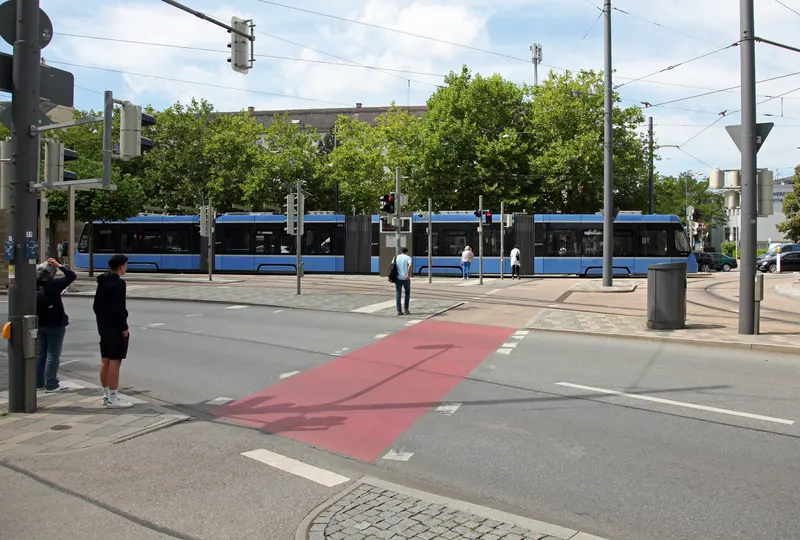
Accessible Munich: A Step-Free Travel Guide
A realistic, planning-led guide to accessible Munich — step-free transport on the U-/S-Bahn and trams, museums and palaces with lift access, the cobbles and surfaces of the Old Town to plan around, and how to reach the city from the airport without stairs.
Read guide
Best Time to Visit Munich
When to come to Munich, season by season and month by month — the tradeoffs of weather, crowds, prices and what's on, from beer-garden summers to the snow-lit Christmas markets.
Read guide
Bike Rental in Munich
How to rent a bike in Munich — rental shops versus the city's public bike-share — where to ride along the Isar and through the English Garden, the lane and traffic rules that keep you safe, and the loveliest easy routes.
Read guide
Driving & Parking in Munich
Whether you need a car in Munich at all, the low-emission Umweltzone rule, parking zones, garages and Park & Ride, and the smarter strategy: ditch the car in the city and rent only for the day trip.
Read guide
Is Munich Safe? A Visitor's Safety Guide
An honest, common-sense read on safety in Munich — how safe the city really is, the few situations to keep your wits about (the station area, festival crowds, pickpockets, cycling), the scams to ignore and the emergency numbers worth memorising.
Read guide
Money & Tipping in Munich
How money works in Munich — cards versus cash, ATMs and fees, how much to tip and the correct way to do it, receipts, and the small habits that keep paying friction-free.
Read guide