
Starkbierfest Munich (Strong-Beer Season)
Munich's Starkbierzeit — the 'fifth season' — is the strong-beer festival held each spring around Lent, centred on the Nockherberg, where Paulaner taps its potent Salvator doppelbock and a comedian roasts the assembled politicians in the famous Derblecken.


- ✓Starkbierzeit, the 'strong-beer season,' is Munich's boisterous spring festival of doppelbock — locally nicknamed the city's 'fifth season.'
- ✓Its spiritual home is the Nockherberg, the Paulaner cellar in the Au, where the potent Salvator beer is ceremonially tapped and a satirical political roast called the Derblecken is staged.
- ✓It is a deeply local, indoors, winter-into-spring affair — far smaller and more Bavarian than Oktoberfest, and a very different experience.
- ✓The dates fall around Lent (roughly March), shift each year, and the big Nockherberg nights book out early, so plan and reserve ahead.
Munich's 'fifth season': what Starkbierzeit is
Ask a Münchner about the city's seasons and they may count five — spring, summer, autumn, winter, and the Starkbierzeit, the strong-beer time. It is the festival that fills the gap between the dark of winter and the first warmth of spring, and it has a very particular flavour. Where Oktoberfest is an open-air, international spectacle, Starkbierzeit is its inward, indoor, intensely local counterpart: warm beer halls rather than tents, dark and powerful doppelbock rather than the golden festival lager, and a crowd that is overwhelmingly Bavarian rather than global.
The beer is the whole point. Doppelbock — "double bock" — is a strong, dark, malty lager, and the tradition runs back to the Paulaner monks who are said to have brewed a rich beer to sustain themselves through the Lenten fast, when solid food was restricted. "Liquid bread," the story goes. That heritage is why the season clusters around Lent, and why the classic strong beers carry names ending in -ator, after the original Salvator. It is festive but it is also genuinely strong, so it rewards a slower pace than a summer beer garden.

The Nockherberg, the Salvator tapping and the Derblecken
The undisputed centre of the season is the Nockherberg, the great Paulaner beer hall on the bluff above the Isar in the Au district. Here the strong-beer festival reaches its peak with the ceremonial tapping of the first keg of Salvator — Paulaner's flagship doppelbock and the beer that gave its name to the whole genre. The opening night is a televised event in Bavaria, and the hall heaves for the duration of the season.
What makes the Nockherberg singular, though, is the Derblecken — a piece of theatre with no real equivalent elsewhere. A comedian takes the stage in the guise of a Lenten preacher (the "Fastenpredigt") and delivers a savage, very funny satirical sermon mocking, by name, the Bavarian and national politicians sitting in the front rows, who are expected to grin and take it. It is followed by the Singspiel, a satirical musical lampooning the same figures. For visitors the humour is fast, idiomatic and in Bavarian-inflected German — much of it will sail past a non-German speaker — but the spectacle, the institution and the atmosphere are remarkable to witness even so.
- The Nockherberg (Paulaner) in the Au is the heart of Munich's strong-beer season.
- The festival opens with the ceremonial tapping of the Salvator doppelbock — a Bavarian TV event.
- The Derblecken is a satirical political roast staged in the hall; the Singspiel follows it.
- The satire is in idiomatic German — gripping to witness, but largely lost on non-German speakers.

Where else to drink it — beyond the Nockherberg
The Nockherberg may be the headline, but strong beer flows across the whole city during Starkbierzeit, and for many visitors the smaller venues are the better experience. Several of Munich's breweries and beer halls hold their own strong-beer weeks and tap their own -ator doppelbocks: the styles and the names vary by brewery, and the festivities are correspondingly more intimate. Löwenbräu's celebrated strong-beer hall and other traditional cellars run lively programmes of their own, often with the same brass bands and long tables but a fraction of the Nockherberg's intensity.
If you want the season's spirit without the crush, seek out one of these smaller halls on a weekday evening, where you can settle in, order a single dark Maß and listen to the band without fighting for a bench. Because each brewery sets its own venue, dates and beer line-up afresh every year, check the current programmes rather than relying on a fixed list — but the general truth holds: from roughly the start of the season you will find -ator doppelbocks on tap all over the city.
- Strong beer is poured citywide during the season, not only at the Nockherberg.
- Several breweries and traditional halls run their own strong-beer weeks with -ator doppelbocks.
- Smaller halls on a weekday evening give the atmosphere without the Nockherberg crush.
- Each venue sets its own dates and beers yearly — confirm the current programmes before you go.
How it differs from Oktoberfest
It is worth being clear, because the two are easily confused: Starkbierfest is not a 'spring Oktoberfest.' They share Munich's beer-festival DNA but differ in almost every practical respect. Oktoberfest is autumn, outdoors on the Theresienwiese, enormous, international and built around golden festival lager. Starkbierfest is late winter into spring, indoors in beer halls, far smaller, overwhelmingly local, and built around strong dark doppelbock.
That changes how you approach it. There is no sprawling fairground, no sea of tents, and the crowd is Bavarian rather than backpacker. The dress is more relaxed than the postcard image of Oktoberfest, though plenty of locals still wear Tracht (Lederhosen and Dirndl) to the Nockherberg, and you will never feel out of place doing so. Above all, pace yourself: doppelbock is considerably stronger than ordinary lager, which is exactly why a couple of Maß go a long way and why the festival has its own legend of unsteady walks home.
- Season: Starkbierfest is late winter/spring (around Lent); Oktoberfest is autumn.
- Setting: indoor beer halls versus Oktoberfest's open-air tents and funfair.
- Crowd: intensely local and Bavarian versus Oktoberfest's international throng.
- The beer: strong dark doppelbock (Salvator and other -ator beers) versus golden festival lager.
- Tracht is welcome but optional — the dress code is more relaxed than Oktoberfest's image.

Planning a visit: dates, reservations and food
Timing first: Starkbierzeit falls around Lent, which in practice means roughly March, with the Nockherberg's festival typically running for a few weeks within that window. The exact dates are set anew each year and the headline Nockherberg evenings — especially the opening and weekends — sell out well in advance, so if your heart is set on the famous hall you should book a table as soon as the dates and reservations open. For the smaller halls you generally have more flexibility, particularly midweek.
On the table, expect the full canon of Bavarian hall food to soak up the strong beer: roast pork (Schweinsbraten), pork knuckle (Schweinshaxe), sausages, dumplings and pretzels. Order food, drink water alongside, and remember that a dark doppelbock at full Maß size is not a session beer. As with every detail here — dates, ticket and table prices, hall hours, the programme of Derblecken and Singspiel — confirm the current specifics with the venue and the official sources before you commit; this is a festival that resets its calendar every single year.
- Timing: around Lent — roughly March — but the exact dates change yearly and must be verified.
- The big Nockherberg nights sell out early; reserve as soon as bookings open if you want them.
- Smaller halls are easier, especially midweek, for a walk-in or last-minute table.
- Eat hearty hall food and pace yourself — doppelbock is much stronger than ordinary lager.
- All dates, prices and hours reset each year — confirm with official sources before planning.

Who it's for, and what to expect from the experience
Starkbierzeit is for the curious traveller who wants to see a side of Munich the postcards miss. It is unapologetically local — the language, the humour, the music and the crowd are Bavarian to the core — and that is precisely its reward. If you relish the idea of being one of the few outsiders in a hall full of Münchners celebrating a centuries-old ritual, the strong-beer season delivers something Oktoberfest, for all its scale, cannot: a sense of being let in on the real thing. It suits beer enthusiasts especially, since doppelbock is a serious and distinctive style worth tasting at its source.
It is a poorer fit for anyone hoping for a polished, English-friendly, tourist-oriented event — there is little hand-holding here, and the satirical centrepiece will largely pass non-German speakers by. Manage your expectations accordingly and you will love it: come for the atmosphere, the dark beer and the spectacle rather than to follow every joke. Practical advice is simple and worth repeating — book the famous nights early, pace yourself against a strong beer, eat well, and consider one of the smaller halls if you want the season's spirit at a calmer pitch. Whatever you choose, confirm the year's dates and details first, because this is a festival that reinvents its calendar annually.
- Best for curious travellers and beer enthusiasts who want an authentic, very local Munich experience.
- A weaker fit for those wanting a polished, English-friendly, tourist-oriented event.
- Come for the atmosphere, the dark doppelbock and the spectacle rather than to follow the satire.
- Book the headline nights early, pace yourself, eat well — and consider a smaller hall for a calmer night.

Frequently asked questions
A few quick answers. Because the festival's specifics change annually, treat dates, prices and hours below as guidance to verify rather than fixed facts.
- When is it? Around Lent, roughly March — but confirm the current year's dates with the venues.
- Where is the main event? The Nockherberg, Paulaner's beer hall in the Au, above the Isar.
- Do I need to book? For the famous Nockherberg nights, yes — they sell out; smaller halls are easier.
- What do I drink? Strong dark doppelbock — Salvator at Paulaner, or other breweries' -ator beers.
- Is it like Oktoberfest? No — it's an indoor, local, late-winter strong-beer festival, much smaller.
- Will I follow the comedy? The Derblecken is in idiomatic German; the spectacle carries even if the jokes don't.
At a glance
A quick planning reference. The dates, prices and hours here are evergreen guidance only — always confirm the current year's details with the Nockherberg and other venues before you travel.
- What it is: Munich's strong-beer season — doppelbock festivities across the city's beer halls.
- Where: centred on the Nockherberg (Paulaner) in the Au; also citywide at other breweries.
- When: around Lent — roughly March — with dates set anew each year; verify before booking.
- The draw: the Salvator tapping, the satirical Derblecken and powerful dark doppelbock.
- Best for: travellers wanting a deeply local, indoor, very Bavarian alternative to Oktoberfest.
- Plan ahead: the headline Nockherberg nights sell out — reserve early; smaller halls are easier.

Munich in March: Strong Beer, Early Spring and Quiet Streets
March is Munich's in-between month — winter loosening its grip, the first warm afternoons appearing among the grey, and the city marking the season with Starkbierzeit, the strong-beer weeks. It's a quiet, good-value time to visit, with the museums uncrowded and the foothills of spring just beginning to show.
Read guide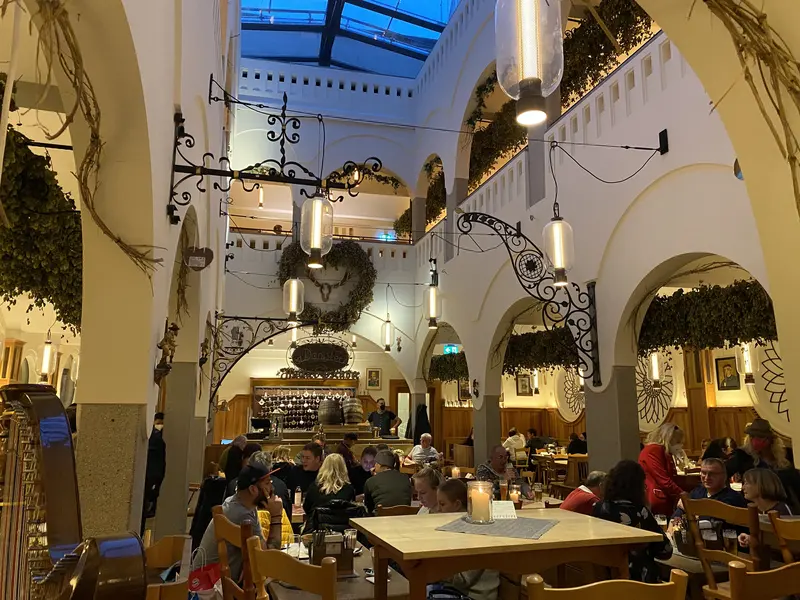
Best Beer Halls in Munich
How to choose among Munich's great beer halls — the Hofbräuhaus, the Augustiner and Löwenbräu houses, Paulaner and more — compared by atmosphere, food, noise and first-time ease.
Read guide
Munich Breweries Guide
The six historic Munich breweries that pour the city's beer and tap at Oktoberfest, the local styles to know, and where to taste each one outside the Wiesn.
Read guideMore in Events
6
Auer Dult, Munich
The Auer Dult is Munich's beloved traditional market fair — part flea market, part household-goods bazaar, part old-fashioned funfair — held three times a year on the Mariahilfplatz in the Au, beneath the spires of the Mariahilfkirche.
Read guide
Filmfest München: A Cinephile's Guide
A practical, cinephile's guide to Filmfest München — Germany's biggest summer film festival — covering when it runs, its venues, how tickets work, where to stay and how to plan a film-packed few days.
Read guide
Munich Christmas Market Food
What to eat and drink at Munich's Christmas markets — from the centrepiece Glühwein and its souvenir mug to roasted almonds, Lebkuchen and stollen on the sweet side, and the grilled sausages, potato pancakes and Käsespätzle that keep you warm on the savoury one, with the order of attack that makes a market evening a proper winter meal.
Read guide
Munich Christmas Markets
The full guide to Munich's Christmas markets — the grand Marienplatz Christkindlmarkt and the smaller, more characterful markets worth seeking out, when the season runs, how to dodge the crowds, what to eat and drink, and how to time a winter trip and its hotel around them.
Read guide
Munich Opera Festival: How to Plan a Summer of Opera
How to plan tickets, hotels and dining around the Munich Opera Festival — the Bavarian State Opera's summer high point at the National Theatre — with practical, evergreen advice and dates to verify each year.
Read guide
Munich Pride and CSD: The Complete Guide
Munich's Christopher Street Day — the city's Pride — fills the streets each summer with the PrideWeeks programme, a big parade and a two-day street festival on Marienplatz. Here's how the weekend works, where to base yourself, and how to take part respectfully.
Read guide