
Best Beer Gardens in Munich
A seasonal guide to Munich's classic beer gardens — the chestnut-shaded benches, the bring-your-own rule, what to order, and which gardens suit families, dates or a quiet pint.

Photo: Sven Mieke / Unsplash

- ✓Bavaria's beer-garden tradition has the force of law: at the self-service tables of a traditional garden you may bring your own food and buy only the beer — locals arrive with a cloth, a radi (radish) and a Brezn.
- ✓The chestnut trees that shade Munich's gardens were planted to keep the beer cellars beneath them cool before refrigeration; that's why the classic gardens are leafy to this day.
- ✓Beer-garden season runs roughly spring to early autumn, weather permitting — most gardens open when it's warm and dry and close or shrink in the cold; check before a special trip.
- ✓Look for the split layout: self-service (Selbstbedienung) benches where bring-your-own applies, and a served (Bedienung) section with tablecloths where you order food and tip — pick the one that suits your plan.
How a Munich beer garden works
A beer garden (Biergarten) is one of Munich's great civilising inventions: a stretch of gravel and wooden benches under big shade trees, where the city comes to sit, drink and unwind from the first warm day of spring to the last of autumn. The shade is no accident. Before refrigeration, brewers dug cellars by the Isar to keep beer cool and planted chestnut trees above them to shield the ground from the sun — and then started serving beer on top. The trees stayed, and so did the custom.
The defining feature, protected by Bavarian tradition and a famous 1995 regulation, is the bring-your-own rule. At the self-service section of a traditional garden you may bring your own food — a picnic, a Brotzeit board, a radi and a Brezn — and buy only your beer. Münchners take full advantage, arriving with a cloth, a chopping board and a spread. You can, of course, buy food at the garden's kiosk too; either way, the beer comes from the brewery the garden is tied to.
Most gardens are split into two zones, and knowing which you're in matters. The self-service (Selbstbedienung) benches, usually the larger, plainer area, are where bring-your-own applies and you fetch your own beer and clear your own glass. The served (Bedienung) section, often with tablecloths, is a normal restaurant terrace where waiters bring food and you tip — and where you should not unpack a picnic. When in doubt, the unserved benches without cloths are the bring-your-own ones.

The classic gardens, and which suits your day
Munich has hundreds of beer gardens, from vast institutions to neighbourhood corners, and the right one depends on what you want from the afternoon. A few are essential. The Chinesischer Turm (Chinese Tower) garden in the English Garden is the most famous and the most central, ringed by a wooden pagoda where a band sometimes plays — lively, leafy and easy to fold into a park walk. The Augustiner-Keller near the Hauptbahnhof is the connoisseur's pick: one of the city's largest and loveliest gardens, under century-old chestnuts, pouring Augustiner from wooden barrels in season.
Beyond those, the Hirschgarten in Neuhausen claims to be one of Europe's largest beer gardens, with a deer enclosure that makes it a favourite with families; the Seehaus and the Aumeister sit at the calmer northern reaches of the English Garden, by the water and among the trees; and the Viktualienmarkt's small garden under the maypole puts a beer a minute from Marienplatz. Each has a different temperature — choose by whether you want spectacle, quiet, a family afternoon or a romantic one.
- Chinesischer Turm (English Garden) — the famous central one, by the wooden pagoda; lively, leafy, sometimes a brass band. Easy to combine with a park walk.
- Augustiner-Keller (near the Hauptbahnhof) — huge, beautiful, century-old chestnuts and Augustiner from the barrel; the locals' and connoisseurs' favourite.
- Hirschgarten (Neuhausen) — one of Europe's largest gardens, with a deer paddock; a top family pick, near Schloss Nymphenburg.
- Seehaus & Aumeister (English Garden) — calmer, greener gardens by the water at the park's quieter northern end; good for a slow afternoon.
- Viktualienmarkt (Altstadt) — a small central garden under the maypole, with the tap rotating among the six breweries; a minute from Marienplatz.
What to order, and the bring-your-own picnic
The drink is straightforward: a Maß (a full litre) of the garden's Helles or a Weißbier, or a Halbe (half) if a litre feels ambitious. In summer many locals order a Radler — beer cut with lemonade — which is lighter and lasts longer in the heat. If you'd rather not drive the bring-your-own ritual, the kiosks at the big gardens sell roast chicken (Hendl), pork knuckle, sausages, Obatzda, pretzels and the famous spiral-cut radish (Radi), salted so it weeps.
But the real beer-garden move is the picnic. Buy a Brotzeit at a supermarket or the Viktualienmarkt — bread, cold cuts, cheese, a radish, fruit — bring a board and a knife, and assemble it on the self-service benches with a litre of beer. It is cheap, sociable and deeply Münchner, and on a warm afternoon under the chestnuts it's one of the loveliest, least touristy things you can do in the city. Bring small cash for the beer kiosk; many still don't take cards.
Gardens for families, and gardens for two
Part of what makes Munich's beer gardens so beloved is that they're genuinely for everyone — a rare kind of place that works for a toddler's afternoon and a couple's evening alike. For families, the standout is the Hirschgarten in Neuhausen, where a fenced paddock of fallow deer (the Hirsch the name refers to) borders the benches and a large playground keeps small children busy while the adults sit. The Chinese Tower garden has a vintage carousel beside it and acres of English Garden lawn to run off energy. At any traditional garden, children are welcome at the tables, and the bring-your-own rule means you can bring exactly the food a fussy eater will accept.
For a romantic afternoon, the calculus flips toward the quieter, greener gardens. The Seehaus sits right on the Kleinhesseloher See in the English Garden, so you can pair a beer with a rowing boat on the lake; the Aumeister, at the park's far northern end, is a leafy, low-key garden that feels miles from the city; and the Augustiner-Keller's deep chestnut shade has a hushed, cathedral quality on a weekday evening. Avoid the band and the carousel, aim for the golden hour, and a beer garden becomes one of the cheapest great dates in the city.
- Best for families — the Hirschgarten (deer paddock and playground) and the Chinese Tower (carousel, lawns to run on).
- Best for two — the Seehaus (on the lake, with boats), the Aumeister (quiet and far north) and the Augustiner-Keller (deep chestnut shade).
- Bring-your-own helps with kids — pack the food children will actually eat and buy only the beer at the self-service benches.

A short history of the chestnut and the bench
The Munich beer garden is not a quaint affectation but the survival of a clever 19th-century solution. Bavarian brewers were long restricted by law to brewing in the cooler months, so to keep beer drinkable through summer they dug deep cellars along the high banks of the Isar and shaded the ground above with broad-canopied chestnut trees and a layer of gravel — all to keep the stored beer cold. Sitting on a barrel of cool beer in pleasant shade, brewers naturally began selling it on the spot, and the beer garden was born.
That success annoyed the city's innkeepers, who lost trade to the breweries, and in 1812 King Maximilian I issued a compromise that still shapes the tradition: the breweries could sell beer in their gardens but were forbidden from serving food, so that customers — to the innkeepers' relief — would bring their own. The right to bring your own Brotzeit, defended again as recently as the 1995 protests over beer-garden regulations, descends directly from that royal fudge. So when you unpack a board of cheese and radish under the trees, you're not breaking the rules; you're honouring a two-hundred-year-old one.

Season, weather and timing
Beer gardens are a fair-weather pleasure, and the season is governed by the sky. Most open through the warmer half of the year, roughly spring into early autumn, and operate when it's dry — a wet, cold day will find tables empty and some gardens closed. Opening dates and hours shift with the weather and from year to year, so check a specific garden before making a special trip; the big ones publish their seasons online.
Within the day, late afternoon into evening is the classic window — the after-work crowd fills the benches from around 17:00, and the long northern summer light keeps the gardens glowing until late. Weekends are busiest; a weekday afternoon is calmest. If you want a romantic table, aim for the golden hour at a quieter garden like the Seehaus or Aumeister; if you want family energy, the Hirschgarten and the Chinese Tower are made for it. And whatever the forecast, bring a light layer — once the sun drops behind the chestnuts, even a warm day cools fast.

At a glance
The rule — at self-service (Selbstbedienung) benches you may bring your own food and buy only the beer; the served (Bedienung) section is a normal terrace where you order and tip.
Top picks — Chinese Tower for central and lively; Augustiner-Keller for the best classic garden; Hirschgarten for families; Seehaus/Aumeister for calm.
What to order — a Maß or Halbe of Helles or Weißbier, a Radler in the heat; Hendl, Haxn, Obatzda, pretzels and radi from the kiosk.
Season — roughly spring to early autumn, weather permitting; late afternoon to evening is the classic window — verify dates and hours.
Good to know — bring small cash and a light layer; weekdays are calmest; you clear your own glass at the self-service benches.

Chinese Tower Beer Garden, Munich
Plan the English Garden's most famous beer garden — the wooden pagoda, the brass band, the self-service benches and the bring-your-own rule, plus the prettiest walking route in.
Read guide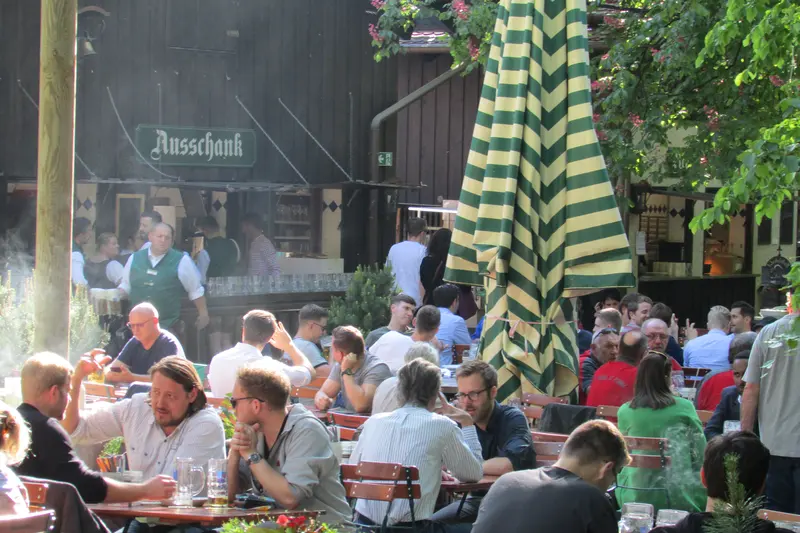
Augustiner-Keller, Munich
The beer garden, the cellar restaurant, reservations and what to order at the Augustiner-Keller near the Hauptbahnhof — the locals' choice for the city's most-loved beer.
Read guide
Munich Beer Garden Etiquette
How a Munich beer garden actually works — the self-service vs served split, the bring-your-own rule, table sharing, reservations, tipping, toasting and clearing your own glass.
Read guideMore in Food & Drink
6
Bavarian Food to Try in Munich
What to order in Munich — Weißwurst, roast pork and pork knuckle, pretzels and dumplings, Obatzda and radi, the cakes and the beers — and the little rules that make each one make sense.
Read guide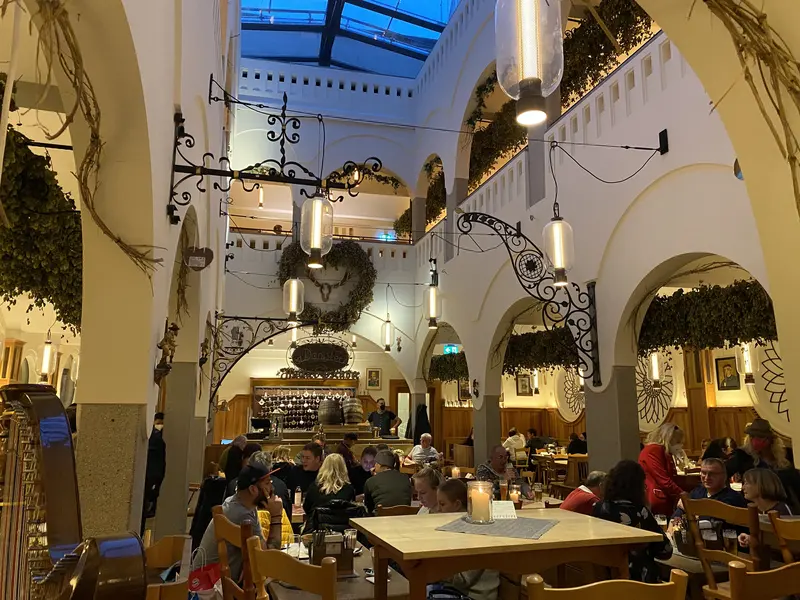
Best Beer Halls in Munich
How to choose among Munich's great beer halls — the Hofbräuhaus, the Augustiner and Löwenbräu houses, Paulaner and more — compared by atmosphere, food, noise and first-time ease.
Read guide
Best Cocktail Bars in Munich
Where to drink well in a beer city — Munich's craft cocktail bars, hotel bars and late-night spots, picked by neighbourhood and vibe for date nights, a refined nightcap or somewhere open into the small hours.
Read guide
Best Coffee and Cafés in Munich
Where to find good coffee in Munich — specialty third-wave roasters, classic Kaffeehaus institutions and konditoreien — sorted by neighbourhood and by whether you want to work, linger romantically or grab a quick cup.
Read guide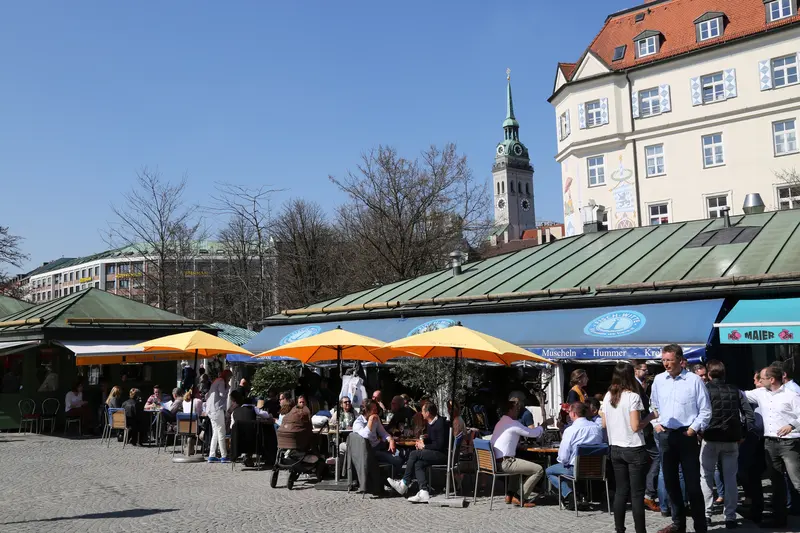
Best Food Markets in Munich
Beyond the famous Viktualienmarkt — the neighbourhood and seasonal markets where Munich actually shops, for snacks, gifts, picnic supplies and a feel for the city's daily rhythm.
Read guide
Best Restaurants in Munich
A traveller-ready shortlist of where to eat in Munich — sorted by neighbourhood, mood, budget and how far ahead you need to book — from beer-hall roasts to candlelit Glockenbach tables.
Read guide