
Munich Spring Festival (Frühlingsfest)
Munich's Frühlingsfest is the 'little sister of the Oktoberfest' — two beer tents, a funfair and a flea market on the Theresienwiese over a couple of weeks of spring, with the same Wiesn ground but a fraction of the crowds.

Photo: Gabriel Sollmann / Unsplash

- ✓The Frühlingsfest is Munich's spring funfair on the Theresienwiese — the very ground that hosts Oktoberfest — but far smaller, calmer and easier to enjoy on the day.
- ✓It runs for about two to three weeks across late April and into May; the exact dates shift each year, so confirm them before planning a trip around it.
- ✓Two beer tents anchor it, alongside a full fairground of rides and a much-loved flea market on the opening weekend.
- ✓It is the relaxed, low-pressure way to taste the 'Wiesn' atmosphere without Oktoberfest's reservations, queues and prices.
The 'little Oktoberfest' on the same famous ground
If Oktoberfest is the global spectacle, the Frühlingsfest is its gentler, more local cousin — and it happens on exactly the same patch of Munich. Each spring the Theresienwiese, the great open field below the statue of Bavaria, is given over once more to beer tents, a funfair and the smell of roast almonds, but on a fraction of Oktoberfest's scale. Münchners call it the "kleines Oktoberfest," the little Oktoberfest, and that is precisely its charm: the same warm, beery, fairground spirit, without the wall-to-wall crowds, the reservation scramble or the international stag parties.
For a visitor, that makes it one of the easiest festivals in the city to simply turn up to. There is no entrance fee to the grounds, the tents are large enough that you can usually find a spot without booking weeks ahead, and the whole thing has the unhurried feel of a neighbourhood fair rather than a bucket-list event. If your trip falls in late April or early May, it is a lovely, low-stakes way to experience the Wiesn tradition — and to see the famous festival ground doing what it does best, months before the world descends in autumn.
The two beer tents and what to expect inside
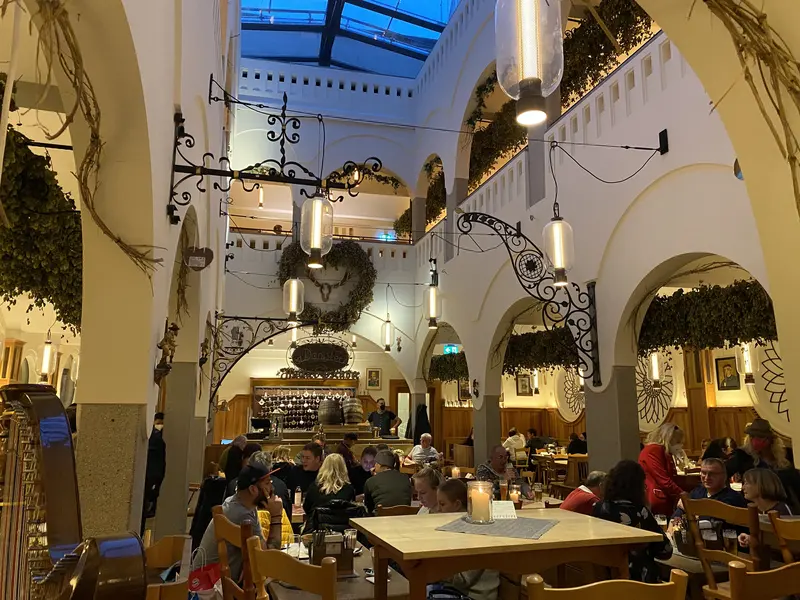
The heart of the Frühlingsfest is its pair of beer tents. They are smaller than Oktoberfest's cathedral-sized marquees but run on the same template: long communal benches, a band playing Bavarian standards and the occasional pop singalong, waitresses carrying improbable fistfuls of one-litre Maß glasses, and hearty plates of roast chicken (Hendl), pork knuckle and sausages. The mood builds through the evening from family-friendly afternoon to full-throated singing later on.
Crucially, the tents here are much easier to get into than at Oktoberfest. On weekday afternoons and early evenings you can often simply walk in and find a free spot at an unreserved table; weekend evenings are busier and a reservation is wise if you want a guaranteed table for a group. As always with Munich beer events, beer is sold by the full litre Maß, prices rise a little each year, and it is cash-friendly though many tents now also take cards — check the current details with the festival before you go.
- Two beer tents — smaller and more relaxed than Oktoberfest's, but with the same bands, food and litre-Maß tradition.
- Weekday afternoons are walk-in friendly; book ahead for a guaranteed weekend-evening table for a group.
- Classic tent food: roast chicken, pork knuckle, sausages and pretzels; beer served by the Maß.
- Prices and payment methods change yearly — verify the current programme before relying on them.
The funfair, the flea market and the family days
Beyond the tents, the Theresienwiese fills with a proper travelling funfair: a big wheel with views over the rooftops to the Alps on a clear day, a swing carousel, ghost trains, bumper cars, children's rides and rows of game and snack stands selling Lebkuchenherzen (gingerbread hearts), candied nuts and cotton candy. It is exactly the spread you would hope for, and on a fine spring evening the lit-up rides against the dusk are genuinely beautiful.
Two extras make the Frühlingsfest distinctive. The first is the flea market, a vast open-air affair traditionally held on the opening Saturday — one of the largest in Bavaria, and a treasure-hunt for bric-à-brac, vintage finds and oddities. The second is the festival's family programming: there are usually designated family days with reduced ride prices, and a closing fireworks display is a long-standing tradition. Because each of these — the flea-market date, the family days, the fireworks night — is fixed anew each year, check the official schedule rather than assuming last year's dates.
- A full funfair: big wheel, carousels, thrill rides, children's rides and classic fairground food stands.
- A huge flea market, traditionally on the opening Saturday — among the biggest in Bavaria.
- Family days with reduced ride prices are usual; confirm the exact dates each year.
- A fireworks display is a traditional highlight, typically near the festival's close — verify timing.
When it happens, and how the dates work
The Frühlingsfest runs for about two to three weeks, beginning in the second half of April and stretching into the first half of May — but the precise opening and closing dates move every year, set by the festival organisers around the spring calendar. Because of that, the single most important piece of planning advice is to confirm the current year's dates on the official festival website before you book flights or hotels around it. Treat any specific date you read elsewhere as needing verification.
Within that window, the rhythm is predictable enough to plan around. Weekends and the evenings are busiest and most atmospheric; weekday afternoons are the quietest and best for families or anyone wanting an easy walk-in. The opening weekend brings the flea market; the closing days usually bring the fireworks. If you have flexibility, a weekday late-afternoon visit lets you wander the funfair in daylight and then settle into a tent as the band warms up — the festival at its most pleasant.

Getting there: the Theresienwiese and transit
The festival is held on the Theresienwiese, the open festival ground just south-west of the centre in the Ludwigsvorstadt district — the same site as Oktoberfest, with the colossal bronze Bavaria statue and the Ruhmeshalle colonnade overlooking it. It is genuinely central and very well served by public transport, which is by far the easiest way to arrive: there is a dedicated Theresienwiese U-Bahn station, and the surrounding stops put you within a short walk of the gates.
Driving is not recommended — parking around the grounds is limited and awkward during the festival, and Munich's transit makes it unnecessary. From the Hauptbahnhof the Theresienwiese is only a short ride or a walk of around fifteen minutes, which makes a station-area hotel especially convenient if you are coming for the festival. Check the current MVV ticketing and the exact station closest to the entrance you want before you set off.
- Location: the Theresienwiese, south-west of the centre in Ludwigsvorstadt — the Oktoberfest ground.
- Easiest arrival: U-Bahn to Theresienwiese (or nearby stops), then a short walk to the gates.
- It's about a 15-minute walk from the Hauptbahnhof — handy if you're staying near the station.
- Skip driving — parking is limited during the festival and the transit links are excellent.


Who the Frühlingsfest is for, and how to do it well
The Frühlingsfest is a relatively young tradition by Munich standards — it began in the 1960s and grew into a fixture of the city's spring — but it has settled into a much-loved rhythm. It suits travellers who want a taste of the famous Wiesn atmosphere without committing to the autumn marathon of Oktoberfest: there is no reservation arms race, no crush of international crowds, and prices and crowds are gentler all round. It is equally happy as a families' afternoon, a couple's evening or a low-key night out, which is part of why locals are so fond of it.
To do it well, lean into its relaxed nature. Come on a fine evening when the rides are lit, wander the funfair and the food stands before settling into a tent as the band warms up, and don't over-plan — half the charm is the lack of pressure. If you are travelling with children, aim for a weekday afternoon and check whether your visit lands on one of the discounted family days. And if you can time it for the opening Saturday, the giant flea market adds a whole extra dimension to the day. As with everything here, confirm the current schedule first, then simply turn up and enjoy.
- A 1960s-born tradition that has become a beloved fixture of Munich's spring.
- Ideal for anyone wanting the Wiesn feel without Oktoberfest's crowds, prices or reservations.
- Works equally for families, couples and a casual night out — no over-planning required.
- Time it for the opening Saturday's flea market or a weekday family day if you can — verify dates.

Frequently asked questions
A few quick answers for first-time visitors. As ever with a festival whose details shift each year, confirm the volatile specifics — dates, hours and prices — with the official source before you rely on them.
- Is it like Oktoberfest? Yes in spirit — same ground, same tents-and-funfair format — but far smaller, calmer and easier to attend without booking.
- Do I need to reserve a table? Not usually for weekday or early visits; a reservation helps for a weekend-evening group.
- Is there an entrance fee? No — the grounds and tents are free to enter; you pay only for rides, food and drink.
- Is it family-friendly? Very — daytime is relaxed, and there are usually family days with cheaper rides.
- How do I get there? Public transport to the Theresienwiese; it's central and a short hop from the main station.
- When exactly is it? Roughly late April into mid-May — but verify the current year's dates with the festival.
At a glance
A quick planning reference. The dates, hours and prices below are evergreen guidance only — always confirm the current year's details with the official Frühlingsfest organisers before you travel.
- What it is: Munich's spring funfair and beer festival — the relaxed 'little Oktoberfest.'
- Where: the Theresienwiese, the Oktoberfest ground, just south-west of the centre.
- When: about two to three weeks across late April and early May — verify the exact dates each year.
- The draw: two beer tents, a full funfair, a big opening-weekend flea market and closing fireworks.
- Best for: anyone wanting the Wiesn atmosphere without Oktoberfest's crowds, prices or reservations.
- Getting there: U-Bahn to Theresienwiese, or a 15-minute walk from the Hauptbahnhof — don't drive.

Oktoberfest Munich: The Complete First-Timer's Guide to the Wiesn
Everything you need for Oktoberfest — when it runs and where, how the fourteen big tents work, whether you need a reservation, what it costs, what to eat and drink, how to get there and where to stay, the etiquette and the traditions, plus a sane first-timer plan. The world's biggest folk festival, explained without the hype.
Read guide
Munich Events Calendar: Oktoberfest, Christmas Markets and the Year's Best
Munich runs on its festivals — Oktoberfest and the Christmas markets are world-famous, but the calendar is full year-round with strong-beer weeks, spring and folk fairs, the seventh-year coopers' dance and more. Here's the year laid out, season by season, with the dates kept current and the volatile ones flagged to verify.
Read guide
Munich in April: Blossom, Beer Gardens and the Frühlingsfest
April is when Munich properly wakes up. The beer gardens reopen, the palace gardens burst into blossom, the Frühlingsfest brings a little spring fairground to the Theresienwiese, and the days grow long and bright — though the weather keeps its famous April habit of changing its mind. A lovely, lively, slightly unpredictable time to visit.
Read guideMore in Events
6
Auer Dult, Munich
The Auer Dult is Munich's beloved traditional market fair — part flea market, part household-goods bazaar, part old-fashioned funfair — held three times a year on the Mariahilfplatz in the Au, beneath the spires of the Mariahilfkirche.
Read guide
Filmfest München: A Cinephile's Guide
A practical, cinephile's guide to Filmfest München — Germany's biggest summer film festival — covering when it runs, its venues, how tickets work, where to stay and how to plan a film-packed few days.
Read guide
Munich Christmas Market Food
What to eat and drink at Munich's Christmas markets — from the centrepiece Glühwein and its souvenir mug to roasted almonds, Lebkuchen and stollen on the sweet side, and the grilled sausages, potato pancakes and Käsespätzle that keep you warm on the savoury one, with the order of attack that makes a market evening a proper winter meal.
Read guide
Munich Christmas Markets
The full guide to Munich's Christmas markets — the grand Marienplatz Christkindlmarkt and the smaller, more characterful markets worth seeking out, when the season runs, how to dodge the crowds, what to eat and drink, and how to time a winter trip and its hotel around them.
Read guide
Munich Opera Festival: How to Plan a Summer of Opera
How to plan tickets, hotels and dining around the Munich Opera Festival — the Bavarian State Opera's summer high point at the National Theatre — with practical, evergreen advice and dates to verify each year.
Read guide
Munich Pride and CSD: The Complete Guide
Munich's Christopher Street Day — the city's Pride — fills the streets each summer with the PrideWeeks programme, a big parade and a two-day street festival on Marienplatz. Here's how the weekend works, where to base yourself, and how to take part respectfully.
Read guide