
The Kocherlball: Munich's Dawn Dance in the English Garden
What to know about the Kocherlball — Munich's beloved early-morning folk dance around the Chinese Tower in the English Garden — its history, when it happens, what to wear and how to join in.

Photo: Bruna Santos / Unsplash

- ✓The Kocherlball is a free, traditional open-air ball held at dawn around the Chinese Tower (Chinesischer Turm) beer garden in the English Garden, on a single Sunday in summer.
- ✓It revives a 19th-century custom in which cooks, maids and servants — the 'Kocherl' — met to dance early on a Sunday morning before their working day began.
- ✓It starts in the small hours and runs through the morning, with live Bavarian music, traditional dance and many people in Tracht (dirndl and lederhosen).
- ✓The date and timings are set each year and the event depends on the weather — treat this as evergreen guidance and confirm the current details before you set an early alarm.
What the Kocherlball is
The Kocherlball is one of Munich's most charming and unusual traditions: a great open-air folk dance held at first light around the Chinese Tower beer garden in the English Garden. On the appointed summer Sunday, thousands of people — many in full Tracht, the dirndls and lederhosen of Bavarian dress — gather on the gravel under the chestnut trees and waltz, polka and dance traditional figures to live brass-and-folk music while the rest of the city is still asleep. It is gloriously of Munich: rooted in old custom, free, sociable, and entirely about the pleasure of the morning.
The name comes from the 'Kocherl' — the cooks — and their fellow domestic servants and maids. In the 19th century, household staff who worked long hours and rarely had free evenings would slip out very early on a Sunday morning, before their employers' day began, to meet in the English Garden and dance. The gatherings grew popular, were eventually frowned upon and banned, and the modern Kocherlball is a fond revival of that lost custom — staged once a year to keep the memory and the music alive. Knowing the backstory makes standing there at dawn, watching couples waltz in the half-light, all the more moving.
- A free, traditional open-air dawn ball at the Chinese Tower in the English Garden.
- Revives a 19th-century custom of cooks, maids and servants dancing early on a Sunday.
- Live Bavarian music, traditional dancing and many people in Tracht.
- One of the city's most distinctive and beloved summer traditions.
When does it happen?
The Kocherlball is held once a year, traditionally on the third Sunday of July, and — true to its origins — it begins in the small hours and runs through the early morning rather than at any civilised daytime. It usually runs roughly from 6 to 10 in the morning: people arrive before dawn to claim a spot, the music and dancing carry on as the light comes up, and the whole thing winds down by mid-morning, after which the area simply becomes the Chinese Tower beer garden again. It is, by design, an event for the very early riser; that's the whole romance of it.
The exact date and start time are fixed each year, and because it's an open-air event held at dawn, it's weather-dependent — heavy rain can affect or move it. So don't set your alarm on the strength of a vague memory: confirm the current year's date, the start time and any weather contingency before you plan a pre-dawn trek across the city. If you're visiting in summer and the timing lines up, it's one of the most memorable mornings Munich can offer.
- Once a year, traditionally the third Sunday of July — starting in the pre-dawn hours.
- Dancing runs roughly 6–10 in the morning, winding down by mid-morning.
- Weather-dependent (it's outdoors at dawn): confirm date and timing each year.
What to wear and how to join in
Half the spectacle of the Kocherlball is the Tracht. Many dancers and onlookers turn out in full traditional dress — dirndls for women, lederhosen for men — and dressing the part is warmly encouraged rather than required. You absolutely don't have to: plenty of people come in ordinary clothes simply to watch, and you'll be welcome either way. But if you have or can borrow Tracht, the Kocherlball is the perfect occasion to wear it, and you'll feel more part of the morning for doing so.
You don't need to be a trained dancer to take part. There's usually a practice or instruction element in the lead-up so that newcomers can learn the basic traditional dances, and the crowd is friendly and forgiving — this is a community celebration, not a competition. If dancing isn't your thing, watching is a joy in itself: find a spot near the floor, let the brass band and the turning couples carry you, and soak up an atmosphere you'll find nowhere else. Whether you waltz or just watch, arriving with an open, easy-going mood is all that's really asked.
- Tracht (dirndl/lederhosen) is warmly encouraged but not required.
- Beginners welcome — there's usually a chance to learn the basic dances beforehand.
- Happy just to watch? A spot near the floor is a wonderful vantage point.
- It's a friendly community celebration, not a performance — come relaxed.

The music, the dances and the mood
What carries the morning is the music. A live band — brass, woodwind and the unmistakable lilt of Bavarian folk — plays from beside the floor while the light comes up, and the repertoire is the old social dancing of the region: the waltz, the polka, the Boarischer and the figure-dances that couples have turned to for generations. The tunes are made for moving rather than listening, and as the dawn warms the gravel the whole space takes on the easy, swaying rhythm of a great-grandparents' ballroom transported under the chestnut trees. Even if you never set foot on the floor, standing in that sound at six in the morning is a small marvel.
The mood is the thing most visitors remember, though. There is something disarming about a crowd of strangers — toddlers, students, pensioners, couples who have clearly been dancing together for decades — all up before sunrise for the sheer joy of it, with no admission, no stage and nothing to sell. It is unhurried, affectionate and faintly dreamlike: the mist lifting, the band playing, dirndls and lederhosen turning slowly in the half-light. Munich does grand spectacle elsewhere; the Kocherlball is its tender, small-hours opposite, and it tends to win over even the sceptics who only dragged themselves out of bed to watch.

How to get there at dawn
Getting to the Chinese Tower in the pre-dawn dark takes a little forethought, because you'll be travelling outside normal daytime hours. The Chinese Tower sits in the middle of the English Garden, roughly in the Schwabing/university direction; the nearest approach is on foot through the park, so plan a route from a transport stop on the garden's edge and allow time to walk in. If you're staying centrally, the walk up through the English Garden as the sky lightens is part of the experience rather than a chore.
At that hour the U-Bahn and night services are your friends — check the current MVV night-network and first-train times, as a regular daytime schedule won't apply before dawn. A taxi or ride to a drop-off near the park edge is the simplest option if you'd rather not work out night transport, after which it's a short walk to the tower. Wherever you come from, leave a comfortable margin: arriving as the first dancers take the floor, with the chestnut trees just emerging from the dark, is the way to see it.
- The Chinese Tower is mid-park — plan a walking route in from the garden's edge.
- It's pre-dawn: rely on the MVV night network or a taxi, not the daytime schedule.
- Staying central? The walk up through the English Garden at first light is half the magic.
- Leave a margin to arrive as the dancing begins.

Make a morning of it
The beauty of the Kocherlball is that it leaves the whole day ahead of you. As the dancing winds down through the morning, the Chinese Tower simply resumes its everyday life as one of Munich's most famous beer gardens, so you can stay put under the chestnut trees for a leisurely breakfast or an early Maß and watch the park wake up. Few Sundays start better than dancing at dawn and then breakfasting where you stood.
From there the English Garden is yours to wander while it's still quiet — down toward the Monopteros and the Eisbach, or along the stream to the surfers' wave at the southern end. Having been up since before sunrise, you'll have seen a side of Munich most visitors never do, and the rest of the day is a bonus. It's the kind of romantic, only-here experience that turns a summer city break into a memory: arrive in the dark, dance into the light, and let the morning unfold from there.


At a glance
A quick reference for planning. The date, start time and weather contingency are set each year — confirm the current details before you set a pre-dawn alarm.
- What: a free, traditional dawn folk-dance at the Chinese Tower in the English Garden.
- When: one summer Sunday a year, starting in the pre-dawn hours and ending mid-morning.
- History: revives the 19th-century early-Sunday dance of cooks and servants ('Kocherl').
- Dress: Tracht warmly encouraged, never required; come to watch or to dance.
- Getting there: walk in through the English Garden; use night transport at that hour.
- After: stay for beer-garden breakfast and a quiet morning in the park.
- Verify: the date, start time and any weather notes change each year.

The English Garden, Munich
How to walk Munich's vast central park — the Eisbach surf wave, the Monopteros viewpoint, the Chinese Tower beer garden, the lawns, the streams and the long route north to the Kleinhesseloher See.
Read guide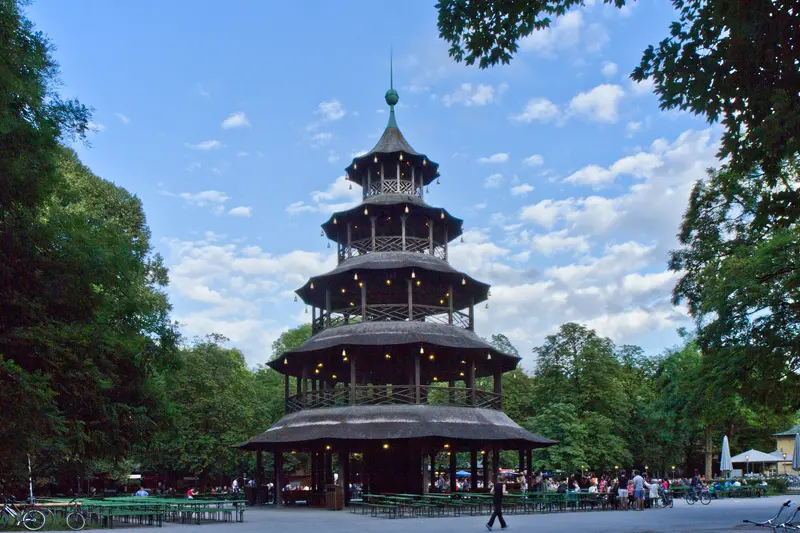
Chinese Tower Beer Garden, Munich
Plan the English Garden's most famous beer garden — the wooden pagoda, the brass band, the self-service benches and the bring-your-own rule, plus the prettiest walking route in.
Read guide
Munich in July: Summer Parks, River Days and the Opera Festival
July is Munich at its warmest and most outdoor-minded. The beer gardens are full, the Eisbach surfers draw crowds, the Isar turns into the city's river beach, and the Opernfestspiele bring world-class opera to the heart of the Altstadt. Long, light-soaked evenings — with the odd dramatic afternoon thunderstorm — make it one of the loveliest, liveliest months to visit.
Read guideMore in Events
6
Auer Dult, Munich
The Auer Dult is Munich's beloved traditional market fair — part flea market, part household-goods bazaar, part old-fashioned funfair — held three times a year on the Mariahilfplatz in the Au, beneath the spires of the Mariahilfkirche.
Read guide
Filmfest München: A Cinephile's Guide
A practical, cinephile's guide to Filmfest München — Germany's biggest summer film festival — covering when it runs, its venues, how tickets work, where to stay and how to plan a film-packed few days.
Read guide
Munich Christmas Market Food
What to eat and drink at Munich's Christmas markets — from the centrepiece Glühwein and its souvenir mug to roasted almonds, Lebkuchen and stollen on the sweet side, and the grilled sausages, potato pancakes and Käsespätzle that keep you warm on the savoury one, with the order of attack that makes a market evening a proper winter meal.
Read guide
Munich Christmas Markets
The full guide to Munich's Christmas markets — the grand Marienplatz Christkindlmarkt and the smaller, more characterful markets worth seeking out, when the season runs, how to dodge the crowds, what to eat and drink, and how to time a winter trip and its hotel around them.
Read guide
Munich Opera Festival: How to Plan a Summer of Opera
How to plan tickets, hotels and dining around the Munich Opera Festival — the Bavarian State Opera's summer high point at the National Theatre — with practical, evergreen advice and dates to verify each year.
Read guide
Munich Pride and CSD: The Complete Guide
Munich's Christopher Street Day — the city's Pride — fills the streets each summer with the PrideWeeks programme, a big parade and a two-day street festival on Marienplatz. Here's how the weekend works, where to base yourself, and how to take part respectfully.
Read guide