
Local Munich Beyond the Old Town
Where Munich actually lives once you've seen Marienplatz — the village-feel neighbourhoods, the riverside, the local cafés and markets, the parks and the beer gardens that locals fill, with a route to weave them into a slower second or third day.


- ✓Munich's local life happens just outside the tourist core — in Haidhausen, the Au, Glockenbach, Schwabing and along the Isar — and it's all within a few minutes by tram, U-Bahn or on foot.
- ✓The Isar is the city's great democratic space: gravel beaches, cycle paths, picnic spots and, in the warm months, locals swimming and sunbathing along the banks.
- ✓Neighbourhood markets, third-wave cafés and small beer gardens give a truer sense of how Munich eats and drinks than anything on Marienplatz.
- ✓You don't need to choose between sights and local life — most of these areas ring the centre and link easily into a second or third day after the Old Town.
- ✓Opening hours, market days and what's currently open all shift; treat specifics here as evergreen guidance and check the volatile details before you go.
Why leave the Old Town at all
Munich's Altstadt is small, beautiful and, on a summer afternoon, very busy. It's also only a sliver of the city. Step a tram stop or two beyond the medieval ring and the crowds thin, the prices ease and a different Munich appears — one of leafy residential streets, corner bakeries, neighbourhood beer gardens and a river full of locals. This is the city people actually live in, and it's where a trip stops feeling like a checklist and starts feeling like a place.
The good news is that none of it is far. Munich is compact and its transit is excellent, so the local neighbourhoods all sit within a short hop of the centre, ringing the Old Town like spokes around a hub. You can spend a morning on Marienplatz and an afternoon somewhere that hasn't seen a tour group all week, and the two will feel like different cities. This guide is a map of that second Munich — the areas, the river, the cafés and markets, the parks — and how to thread them into a slower second or third day.
Think of it as a change of register rather than a change of place. You're not abandoning the sights; you're widening the lens to take in the everyday city around them — the way Müncheners shop, eat, walk and unwind. That's the version of a place you remember years later, long after the dates and ticket prices have blurred: a particular café terrace, the smell of a market stall, an evening on the river with the light going. The aim of this guide is to point you toward those moments rather than away from the monuments.


Haidhausen — the French Quarter and village squares
Across the Isar from the centre, Haidhausen is the easiest local neighbourhood to fall for. Its so-called French Quarter is laid out in elegant nineteenth-century streets named after French towns and battles, with small leafy squares — the Pariser Platz, the Bordeauxplatz — that feel more like a provincial town than a big-city district. The pace is unhurried, the cafés are local, and the dinner spots are the kind Müncheners actually book.
It's also a culture stop: the area is home to the concert and cultural complex on the Isar's east bank, and its squares make natural pauses on a wander. Come for an early-evening stroll, settle at a café terrace on one of the round platzes, and eat dinner somewhere unshowy and good. Haidhausen is the answer to 'where do locals go that's still pretty?' — and it's a ten-minute hop from the centre.
The Au — riverside, festivals and old Munich
Just south of Haidhausen, hugging the Isar's east bank, the Au is one of the most characterful and least touristed corners of inner Munich. It keeps a strong local identity, with old workers' housing, the slope up to the Nockherberg — home to the famous strong-beer season — and the Auer Dult, a traditional fair-cum-flea-market held on Mariahilfplatz several times a year, selling crockery, antiques, oddities and street food beneath a fairground.
There's no headline sight here, and that's the point. The Au is where you go to feel old Munich at street level: a riverside walk, a beer at a local Wirtshaus, the Dult if your dates line up, and the quiet satisfaction of being somewhere most visitors never reach. Pair it with the Isar walk below — the two run side by side.
The Isar — the city's great open-air living room
If there's one thing that explains how Munich actually lives, it's the Isar. The river runs green-grey straight through the city, and unlike many urban rivers it's been re-naturalised in stretches, with gravel banks, shingle beaches and shallow braided channels. In the warm months these banks fill with locals: families picnicking, swimmers in the (cold, fast, treat-with-respect) current, sunbathers on the stones, cyclists threading the paths, and barbecue smoke drifting where it's allowed. It is the most democratic, most genuinely local space in the city.
You can join in with almost no planning. Walk or cycle the riverside paths between the centre and the Flaucher area to the south, where the banks open into broad gravel beaches and a classic beer garden waits among the trees. Bring a picnic, find a flat stone, and watch the city relax. A word of caution: the Isar moves fast and cold, water levels change, and swimming carries real risk — go in only where locals do, never alone in strong current, and check conditions first.
- Walk or cycle the riverside paths — flat, scenic and car-free for long stretches.
- Head south toward the Flaucher for gravel beaches and a tree-shaded beer garden.
- Bring a picnic; the banks are made for it in the warm months.
- Respect the river: cold, fast and changeable — swim only where locals do, and check conditions.
Glockenbach and Isarvorstadt — bars, design and the river's edge
On the west bank, between Sendlinger Tor and the river, the Glockenbachviertel and the wider Isarvorstadt are where Munich goes out. This is the city's most stylish and liveliest quarter — small bars, design boutiques, independent shops, good restaurants and the heart of Munich's LGBTQ+ scene — all packed into walkable streets that buzz from early evening. It's close enough to the Old Town to fold into a single day, but it feels a world away from the souvenir shops.
Come for an aperitivo and stay for dinner: graze the boutiques in the late afternoon, settle into a candlelit table or a wine bar as the light goes, then drift toward the Gärtnerplatz, the pretty round garden square that anchors the quarter and fills with people on warm nights. It's the natural local evening to a day that started with sightseeing.

Schwabing — bohemian cafés and the park's edge
North of the centre, Schwabing is Munich's classic bohemian quarter — once the haunt of artists and writers, now a handsome, leafy district of cafés, bookshops, brasseries and turn-of-the-century apartment houses. It runs right up to the long eastern edge of the English Garden, which means you can drift from a coffee on a Schwabing corner straight into the city's greatest park within minutes.
It's an easy, low-effort kind of local: there's no single must-see, just the pleasure of a good café, a stroll under the plane trees, and the option of the park whenever you want it. Combine it with the English Garden below for one of the best slow days in the city — coffee, lawns, a beer garden and a riverside path, all linked on foot.
Schwabing is also the place to understand why Munich attracts the people it does. A century ago it was the bohemian heart of the city, full of painters and writers; today it's prosperous and polished but still café-centred, still walkable, still built around the idea that a good afternoon is one spent outdoors with a coffee and no particular plan. Sit on a corner terrace for an hour and you'll absorb more of the city's character than another monument could give you.


Parks and beer gardens the locals actually use
The English Garden gets the headlines — and rightly, since it's larger than New York's Central Park, with the Eisbach surfers at its southern tip, the Monopteros temple on its little hill, lawns that fill on any warm day, and the Chinese Tower beer garden in its heart. But the trick to seeing it like a local is to walk north, away from the busy southern end near the centre, into the quieter expanses where Müncheners come to lie in the grass, swim in the stream and drink at the Aumeister at the far end.
Beyond it, the city is ringed with beer gardens that locals fill on warm evenings — the great chestnut-shaded gardens where, by Bavarian custom, you may bring your own food to the unserved tables and buy only your Maß. These are the city's communal living rooms: cheap, democratic and unmistakably local. Choosing a neighbourhood garden over a famous one, and a weekday over a weekend, is the surest way to drink where Munich actually drinks.
- Walk the northern English Garden for the quiet, local end of the park.
- Pick a neighbourhood beer garden over a landmark one for the real local feel.
- Bring your own food to traditional gardens and buy only the beer — it's the custom.
- Go on a weekday evening to drink where locals do, not where tour buses stop.

Westend and the quieter west side
West of the centre, beyond the festival grounds at the Theresienwiese, the Westend is one of inner Munich's most genuinely lived-in quarters — a former working-class district now full of cafés, small restaurants and a relaxed, mixed, unpolished energy that feels a world from Maximilianstraße. It rewards a wander with no agenda: corner Wirtshäuser, ethnic food alongside Bavarian classics, and streets where you'll hear far more everyday German than English. It's also handy as a base, with better value than the Old Town and quick transit in.
Further out in the same direction, Neuhausen-Nymphenburg blends a calm residential feel with real attractions — the palace and its park, and some classic beer gardens — making it a natural pairing of local life and a headline sight. The lesson of the west side is the same as the river's east bank: you don't have to choose between seeing something and feeling somewhere. Pick a quarter, give it an afternoon, and let the city's ordinary life do the rest.

Markets and everyday eating
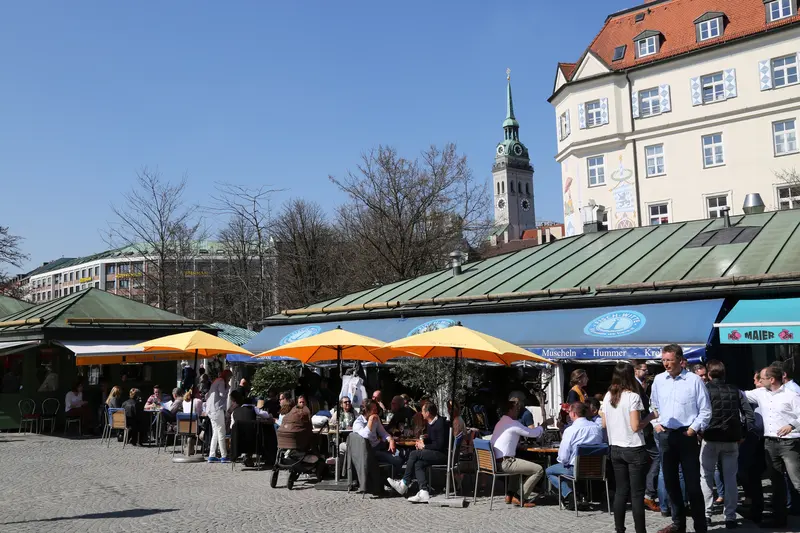
The Viktualienmarkt by Marienplatz is wonderful but well-discovered; the more local move is to combine it with a neighbourhood market or simply to eat the way Müncheners do day to day. That means a Brezn and a coffee from a bakery in the morning, a stand-up Leberkässemmel or a market lunch at midday, and an early dinner in an unfussy Wirtshaus or a neighbourhood restaurant in one of the areas above. The food gets less performed and more honest the further you get from the postcard square.
Munich's markets reward the same instinct as its neighbourhoods: go a little off-centre. Smaller weekly and seasonal markets across the districts sell flowers, produce, cheese and street food to locals rather than tourists, and the traditional fairs — the Auer Dult chief among them — are pure neighbourhood theatre. Use the food markets guide to find the ones near wherever you're staying, and treat a market lunch as the cheapest, truest taste of the city.
The everyday Munich plate is unfussy and easy to find once you know what to look for: a Brezn from the bakery, a Leberkässemmel from the butcher's counter, a bowl of soup or a plate of Schnitzel in a neighbourhood Wirtshaus, a Weißwurst before noon if you want the full ritual. None of it requires a reservation or a guidebook recommendation; it's the food locals eat on an ordinary Tuesday, and it tastes better for being unperformed. Pair it with a beer from one of the city's six breweries and you've eaten Munich exactly as Müncheners do.

Getting around the way locals do
The single biggest shift in seeing the local city is how you move through it. Münchners don't shuttle between headline sights on the U-Bahn; they walk, cycle and tram their way around their own districts, and so should you. The neighbourhoods above are far closer together than they look on a transit map — Haidhausen to the Au to the Isar, or Glockenbach to Gärtnerplatz to the river, are all gentle strolls — and the joy of them is in the streets between, the squares, the shopfronts and the little glimpses of the river, none of which you see from underground.
For anything longer, hire a bike. Munich is flat, calm and laced with dedicated cycle paths, and the riverside Isar routes in particular are a local institution — you can ride from Schwabing down through the English Garden and along the water to the southern beaches in an unhurried hour, peeling off into a neighbourhood or a beer garden whenever the mood takes you. The city's bike-share and rental schemes make it easy to grab a bike for a stretch and drop it again, and on a fine day it's both the fastest and the most pleasant way to cover the local city. When you do need transit, the trams beat the U-Bahn for this kind of exploring: they run above ground, thread the districts directly, and let you watch the neighbourhoods slide past rather than tunnelling blindly beneath them. One MVV day ticket still covers whichever you use.

How to time it like a local
Seeing the local city is partly about where you go and partly about when. Munich's everyday rhythm has its own clock, and matching it is the difference between feeling like a visitor and feeling like you belong for an afternoon. Mornings belong to bakeries and markets, when the produce is freshest and the cafés fill with people reading the paper over coffee. Sundays change the whole texture of the city: most shops close, so locals decamp to the parks, the river and the beer gardens — which makes a Sunday, counterintuitively, one of the best days to see Munich relax, as long as you've eaten and shopped on the Saturday.
Evenings tip toward the river and the beer gardens in summer, and toward the neighbourhood Wirtshäuser and the bars of Glockenbach the rest of the year. Weekdays are quieter and more local than weekends, when the famous spots draw crowds; a Tuesday evening in a neighbourhood garden feels very different from a Saturday one. None of this needs planning — it just rewards going with the grain of the city rather than against it. Check market and fair days and any seasonal opening hours before you build a plan around a specific one.
- Mornings: bakeries, markets and unhurried café coffee.
- Sundays: shops shut, so locals fill the parks, river and beer gardens — shop on Saturday.
- Weekday evenings feel far more local than crowded weekends.
- Go with the city's rhythm rather than against it — and verify market/fair days.

Weave it into a slower second day
Here's one way to string the local Munich together once the Old Town's done. Start with a Schwabing coffee, then walk south through the English Garden — lawns, the Monopteros, the Eisbach surfers — to the river. Pick up the Isar and follow its banks south past the gravel beaches, crossing to the east side for a wander through Haidhausen's French Quarter and a pause on one of its round squares. Drop down into the Au for the riverside and, if your dates align, the Auer Dult. Finish the evening back on the west bank in Glockenbach, with a wine bar and a late dinner around the Gärtnerplatz.
It's a full but unhurried day, almost all on foot or with a single short tram or U-Bahn hop, and it sees no headline monument at all — which is exactly why it leaves you feeling like you've actually been to Munich rather than just photographed it. Adapt the order to where you're staying and how the weather's running; the beauty of these areas is that they all connect, and none of them is far. As always, check market days, fair dates and opening hours before you build a plan around any single one.
If you'd rather not commit to the whole loop, treat it as a menu. Any single leg makes a fine half-day on its own: a Schwabing coffee and the northern English Garden; an Isar walk to the Flaucher beer garden and back; an evening of Haidhausen squares and a French Quarter dinner; or a Glockenbach aperitivo-and-dinner crawl around the Gärtnerplatz. The point isn't to march the full route — it's to spend a few hours where Munich lives, at whatever pace suits the day. Pick the leg that matches your mood and the weather, and save the rest for next time.
- Schwabing coffee → English Garden → Isar banks → Haidhausen → the Au → Glockenbach for dinner.
- Almost all walkable, with at most one short tram or U-Bahn hop.
- No headline sight required — the point is the lived-in city, not the checklist.
- Reorder to suit your base and the weather; everything here links up easily.


Haidhausen, Munich
Munich's most village-like central quarter, just over the Isar — the French Quarter's pretty streets and squares, an excellent dinner scene, the Gasteig/HP8 culture campus, and a quietly romantic place to stay.
Read guide
Au, Munich
A local-feeling riverside quarter on the Isar's east bank — home to the thrice-yearly Auer Dult market, the Nockherberg and its strong-beer season, and quieter food and evenings away from the crowds.
Read guide
The Isar River, Munich
Munich's wild green river — where to walk and cycle, the gravel beaches and the Flaucher, the swim-season caveats, and the loveliest sunset stops along the water.
Read guideMore in Itineraries
6
A Weekend in Munich
A Friday-to-Sunday weekend in Munich planned the way a city break actually runs — arrival-evening logic, a full Saturday of sights and gardens, a slower Sunday that works around the shops being shut, with hotel-area, dinner-timing and no-wasted-transit advice throughout.
Read guideFour Days in Munich
A slower four-day Munich itinerary that adds the things three days has to skip — a proper neighbourhood day, more museums and beer gardens, and one big day trip into the Alps or to the lakes — built for travellers who want to live the city rather than tick it off.
Read guide
Luxury Munich Itinerary
A high-end, unhurried plan for Munich — grand-dame and design hotels, private guides, fine dining, palaces and treasuries, the opera, and an Alpine or lakeside add-on, built around comfort and time rather than a packed schedule.
Read guide
Munich Airport Layover Guide
How to spend a layover at Munich Airport — when a dash into the city is realistic, how long you really need, what to do without leaving, and when it's smarter to stay near the terminals.
Read guide
Munich Art & Museums Itinerary
A rain-proof culture itinerary for Munich — a focused day in the Kunstareal among the Pinakotheken and the Blue Rider, a science day at the Deutsches Museum, and a cars-and-modern-architecture option around BMW and Olympic Park, with how to pair them without museum fatigue.
Read guide
Munich Beer Garden Itinerary
A relaxed warm-weather route through Munich's classic beer gardens — from the English Garden's Chinese Tower to the Augustiner-Keller's century-old chestnuts and a riverside finish — with the bring-your-own etiquette, what to order, and the transit that links them.
Read guide