
Viktualienmarkt, Munich
How to eat, shop and linger at Munich's open-air food market a minute from Marienplatz — the stalls, the beer garden under the maypole, and the unwritten rules that make it work.

Photo: Sarah Donovan / Unsplash

- ✓A permanent open-air food market just south of Marienplatz, trading on the same square since 1807 — roughly 22,000 square metres of stalls, fountains and chestnut trees.
- ✓The beer garden in the middle has no fixed brewery: the city rotates the tap among Munich's six breweries through the year, so the beer changes with the season.
- ✓Most stalls keep daytime shop hours and close on Sundays and public holidays — come on a weekday morning for the fullest, calmest market.
- ✓It is a working market, not a museum: graze standing up, but the stallholders are here to sell, so buy something before you settle in.
A working market, two minutes from Marienplatz
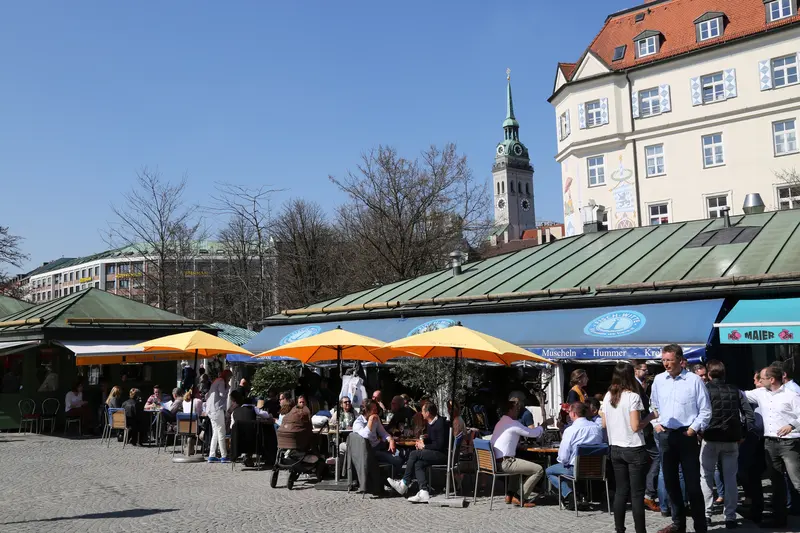
Walk south off Marienplatz, past the spire of Alter Peter, and the city opens into the Viktualienmarkt — Munich's daily food market and its open-air larder. The name comes from the Latin victualia, provisions, and that is exactly what it has sold since the market outgrew Marienplatz and moved here in 1807. What began as a peasants' produce market is now a permanent run of stalls spread over a square the size of a couple of football pitches, hemmed by the old town on every side and shaded by plane and chestnut trees.
It has never stopped being a place where Münchners actually shop. You'll see chefs picking herbs, office workers queuing for a fish roll at noon, and grandmothers debating the ripeness of a Williams pear. That is the pleasure of it: you are not visiting a recreated old market but standing in a living one. Graze as you go — a few cherries here, a slice of cheese there — but remember the etiquette that keeps it working. Buy before you browse too long, don't photograph a stallholder's face without a nod, and have small change ready.
Give it twenty minutes if you're just passing through to Marienplatz, or build a slow hour around lunch and a beer. Either way, the Viktualienmarkt is the most enjoyable way to eat your way across central Munich without a single restaurant booking.
How the market grew — and why it feels like a village
The Viktualienmarkt's charm is partly its scale and partly its accidental geography. When the original market on Marienplatz could no longer hold the city's grocers, King Maximilian I ordered it relocated south to the present square in 1807, and it simply kept spreading from there, swallowing adjacent plots over the following decades until it reached today's footprint of roughly 22,000 square metres and around 140 stalls and shops. Because it grew piecemeal rather than to a single plan, it has the irregular, layered feel of a small village dropped into the middle of a city — lanes that widen and narrow, fountains tucked between stalls, a particular trade clustered in one corner.
Those fountains are worth noticing. Several honour Munich's beloved folk performers and comedians — Karl Valentin, Liesl Karlstadt, Weiß Ferdl, Ida Schumacher and others — a reminder that this was always a place of characters as much as commerce. The market women, the Marktfrauen, were and are famous for their sharp tongues and their refusal to be hurried; the whole square runs on a kind of brisk, affectionate banter that you'll catch even without German. Stand still for a minute by a stall and you start to feel the rhythm of it — a working square that has fed Munich for more than two centuries and still does.
It is also one of the few corners of the old town where prices and produce shift visibly with the seasons, which is half the pleasure of returning. The same stall that pyramids strawberries and white asparagus in May piles chanterelles, plums and Federweißer in September, and hangs greenery and gingerbread in December. Come twice in a year and you've seen two different markets.
What to eat: graze stall to stall
The market is built for grazing, and the best meal here is an assembled one — a roll from one stall, fruit from the next, a sweet to finish. There are no waiters and no menus; you walk, you point, you pay, you eat standing up or carry it to the beer-garden benches. The classics below are worth seeking out, and most have stood in the same spot for decades, but the real method is to let the smell of smoked fish or warm Brezn pull you off course.
- Fish rolls and smoked fish — the fish stalls do a brisk lunchtime trade in Fischsemmeln (herring or mackerel in a crusty roll) and hot, oily smoked fish on a stick. A Munich institution and a cheap, excellent standing lunch.
- Cheese and charcuterie — counters of Bavarian and Alpine cheeses, mountain hams and sausages, cut to order. Ask for a small wedge and a slice; nobody minds a modest purchase.
- Fruit, veg and exotics — seasonal Bavarian produce sits beside figs, dates and out-of-season imports. Strawberries and white asparagus in spring, mushrooms and pumpkins in autumn.
- Honey, nuts and dried fruit — the spice and dried-goods stalls are good for picnic supplies and tidy souvenirs that survive a suitcase.
- Sweets and a Prinzregententorte — bakery and confectionery stalls sell strudel, gingerbread and slices of Munich's layered chocolate-and-buttercream Prinzregententorte.
- A Brezn and a Weißwurst — a soft pretzel is the obligatory market snack; if it's before noon, the traditional window for Weißwurst, eat the white veal sausage peeled, with sweet mustard.
The beer garden under the maypole
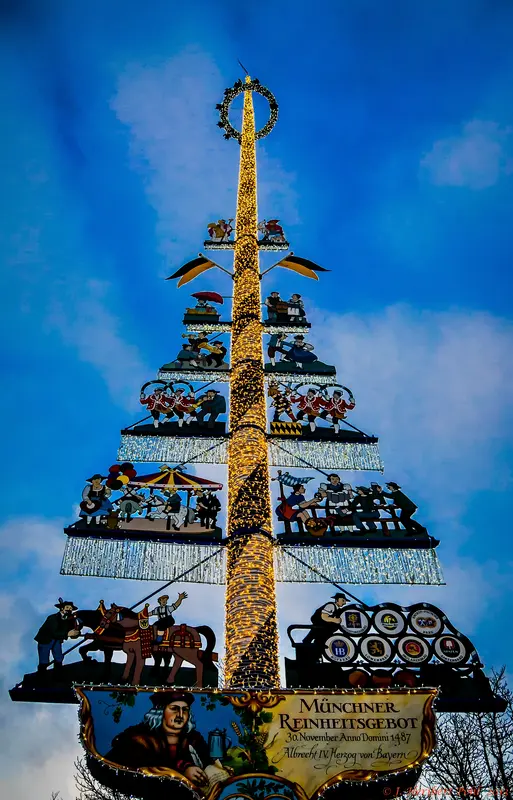
At the heart of the market is one of central Munich's most convenient beer gardens — a cluster of benches in the shade beside the blue-and-white maypole (Maibaum), the painted pole whose carved figures advertise the local trades. Unlike a brewery's own garden, this one has no permanent tap: the city rotates the beer among Munich's six big breweries — Augustiner, Paulaner, Hacker-Pschorr, Hofbräu, Löwenbräu and Spaten — across the year, so what's poured changes with the season. A board by the bar tells you whose beer it is this week.
Bavarian beer-garden custom applies in its purest form here: at the self-service benches you may bring your own food (a roll and cheese bought five metres away counts), and you buy only the drink. Order a Maß or a Halbe at the kiosk, find a spot, and you've turned the market into lunch. It's a genuinely lovely thing to do on a warm day — a beer in dappled light, the murmur of the stalls around you, Alter Peter's bells marking the hour overhead.
It is also, quietly, one of central Munich's most romantic cheap dates. There's no booking, no fuss and no rush; you share a board of cheese, ham and fruit gathered from the surrounding stalls, split a litre of whichever brewery is pouring, and watch the city go by under the chestnut trees. In the colder months the garden contracts but doesn't disappear, and a few stalls keep mulled-wine and hot-food going through winter, so the square stays a place to pause even when the leaves are down. Compared with the queues and prices of the nearby Hofbräuhaus, it's the locals' move.

When to go, and how to fold it into a day
Timing matters more here than anywhere else in the old town, because the Viktualienmarkt keeps shop hours, not tourist hours. The stalls trade through the day on weekdays and Saturdays and are closed on Sundays and public holidays — so a Sunday-morning visit finds an empty, shuttered square. A weekday late morning is the sweet spot: the stalls are fully stocked, the lunch rush hasn't peaked, and the beer garden is filling but not full. (Exact hours vary by stall and season — verify before a special trip.)
The market sits so close to Marienplatz that it folds into almost any old-town plan. Catch the Glockenspiel at eleven, climb Alter Peter for the view down onto the square, then drop into the market for a grazing lunch and a beer before walking on to the Residenz or the Frauenkirche. In the run-up to Lent the market hosts the boisterous market-women's dance on Shrove Tuesday (Faschingsdienstag), and in December a small Christmas-market mood settles over the stalls — both worth catching if your dates line up.
One practical note: it is busiest and most expensive at the obvious times and right by the main aisles. Step one row back from the central path and prices ease and queues shorten. And bring cash — while more stalls now take cards, the smallest and best traders still prefer coins.
For all the practicalities, the Viktualienmarkt is at its best when you stop planning it. Buy more than you meant to, find a sunny bench, and let an hour go. The market has fed Munich through monarchy, war and reconstruction without losing its temper or its produce, and an unhurried lunch here — a fish roll, a wedge of mountain cheese, a Maß and a Brezn — is one of the truest, least touristy pleasures the old town offers.

At a glance
Location — Viktualienmarkt 3, in the Altstadt, about a two-minute walk south of Marienplatz (U-/S-Bahn Marienplatz).
Type — permanent open-air daily food market with a rotating-brewery beer garden; free to enter, pay per stall.
Hours — daytime shop hours Monday to Saturday; closed Sundays and public holidays. Individual stalls and the beer garden vary seasonally — verify.
Best time — a weekday late morning for the fullest, calmest market; warm-weather lunchtime for the beer garden.
Good to know — bring small cash; buy before you settle at a bench; the beer brand rotates through the year, so check the board.
Viktualienmarkt Food Guide
What to eat at Munich's famous Viktualienmarkt, when to go, and how to use it for a fast, characterful lunch a minute from Marienplatz — stalls, snacks and a picnic to carry out.
Read guide
Where to Eat Near Marienplatz
Reliable lunches, snacks and dinners around Munich's busiest square — how to skip the tourist mark-ups by stepping a street back, and exactly where to go for a market lunch, a quick bite or a proper Bavarian meal.
Read guide
Marienplatz, Munich
How to see Munich's central square — the New Town Hall and Glockenspiel, the Marian Column, the Old Town Hall and the food stops a minute away.
Read guideMore in Things to Do
6
Allianz Arena, Munich
How to visit Munich's glowing football stadium — the self-guided Erlebnistour, the FC Bayern Museum, match-day logistics, and the easy U6 ride out to Fröttmaning.
Read guide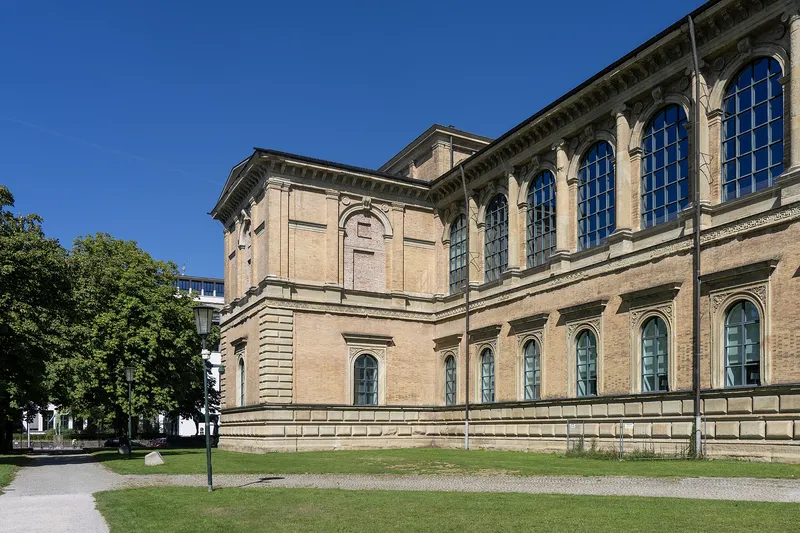
Alte Pinakothek, Munich
How to visit Munich's Old Masters gallery in the Kunstareal — the Dürers and Rubenses worth crossing town for, the Sunday-ticket angle, and how to build a wider museum-quarter day around it.
Read guide
Asamkirche, Munich
How to visit Munich's astonishing late-Baroque Asamkirche on Sendlinger Straße — the church two brothers built next to their own house — without overplanning it.
Read guide
Best Munich Tours
When a guided tour earns its place in a Munich trip — and which kind to pick. Old Town walks, food and beer crawls, football and BMW, the Third Reich history walk, and the big castle and Dachau day trips, weighed by time, cost and effort.
Read guide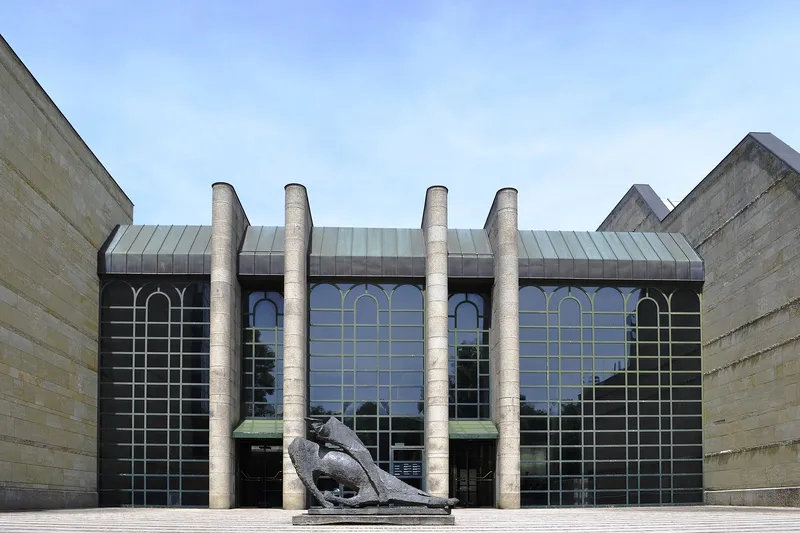
Best Museums in Munich
Choose the right Munich museum for you — by interest, by how much time you have, by which day of the week, and by how useful it is on a rainy day.
Read guide
Best Photography Spots in Munich
Rooftops, squares, churches, parks and palaces — the most photogenic places in Munich, with the light and timing notes to shoot each one well.
Read guide